
Bracelet sizes & prices
Prices in Philippine pesos, per finished bracelet, for the named variants below. Our team confirms availability, wrist fit, and the final amount before payment.
Labradorite
| Bead size / style | Price per bracelet |
|---|---|
| 6 mm | ₱799.00 |
| 8 mm | ₱999.00 |
| 10 mm | ₱1,399.00 |
| 12 mm | ₱2,799.00 |
| Chipstone | ₱350.00 |
Labradorite (Grade 7A)
| Bead size / style | Price per bracelet |
|---|---|
| 10 mm | ₱1,899.00 |
| 12 mm | ₱2,799.00 |
Grade labels are supplier descriptions.
Choose your bracelet and send an order inquiry · View the complete price guide
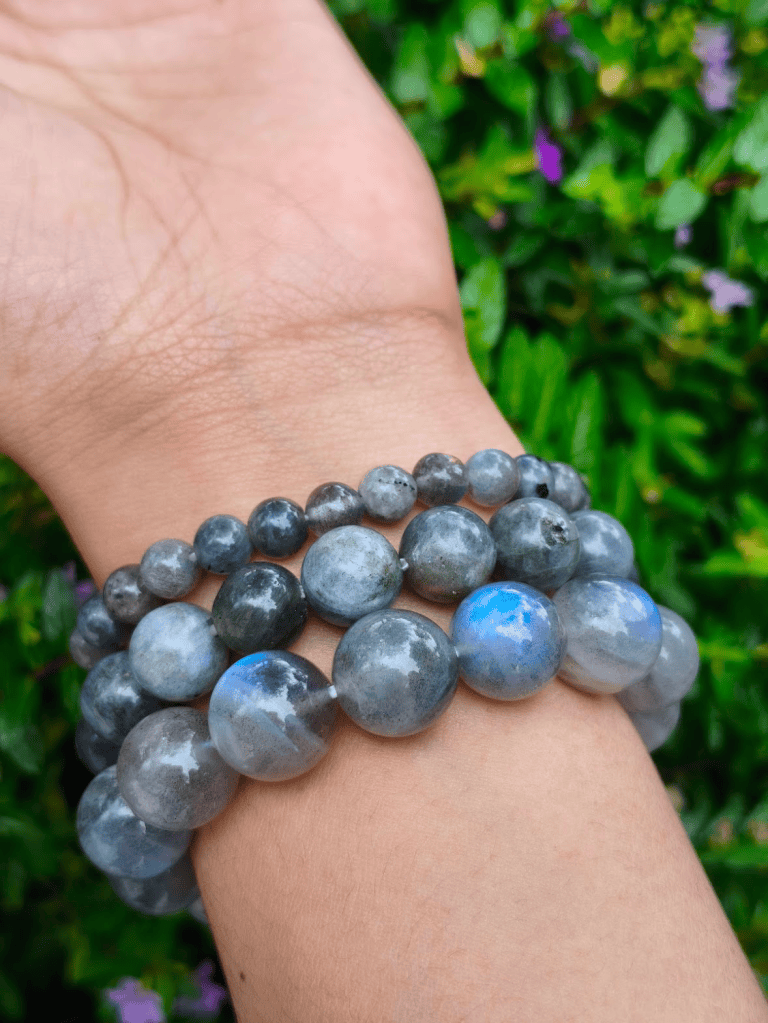
Choose your bead size and wrist circumference on the order form. Our team will confirm available materials and the final price before payment.
Material reference
Labradorite · Liwanag sa Likod ng Anino
Scientific identity, documented history, and community contexts are presented with sources. TÁWID’s contemporary design interpretation is identified separately.
Material identity
Labradorite is a variety of plagioclase feldspar. Its coloured flashes, called labradorescence, result from light interacting with microscopic internal layers. The stone may look grey from one direction and flash blue, green or other colours from another. Cutting orientation and viewing angle therefore play an important part in what a finished bead or cabochon displays. [1]
Documented historical context
In a 2020 European Geosciences Union conference contribution, geologist Andrew Kerr places the material’s early European scientific history on the Labrador coast, now part of Nunatsiavut in Canada. He reports collection by a Moravian missionary around 1773 and naming by Abraham Werner in 1780. These dates concern collection and scientific naming; they should not be presented as the first time local people encountered the stone.
Oxford’s Corsi Collection preserves labradorite within a nineteenth-century system of decorative-stone classification. Its commentary notes subsequent decorative sources in Finland and Madagascar. This connects the material to collecting, comparative geology and changing supplies for ornament. Oxford also distinguishes it from another blue-flashing feldspar in Norwegian larvikite. A luminous blue appearance can therefore invite comparison without establishing identical mineral composition.
Together, the scientific and collection records offer a history of observation and decorative use. A modern bracelet’s source still needs its own documentation, and a generalised Northern Lights story should not be assigned to an unspecified Inuit community without a suitable cultural source. [2] [3]
TÁWID’s contemporary interpretation
Liwanag sa Likod ng Anino is TÁWID’s contemporary reflection on work and skills that may receive little recognition.
References
- GIA, “Structures Behind the Spectacle,” Gems & Gemology (Summer 2025)
- Andrew Kerr (2020), “Labradorite gemstones and related ornamental stones from the type area on the coast of Nunatsiavut (Labrador), Canada,” EGU 2020-13222
- Oxford University Museum of Natural History, Corsi Collection, Labradorite, specimen 705


Leave a Reply