TÁWID™ COLLECTIONS
Material first.
Story always.
Browse by material family, then choose the piece whose texture, form, and story feel right for you. Send a screenshot or reference to confirm current availability and price.
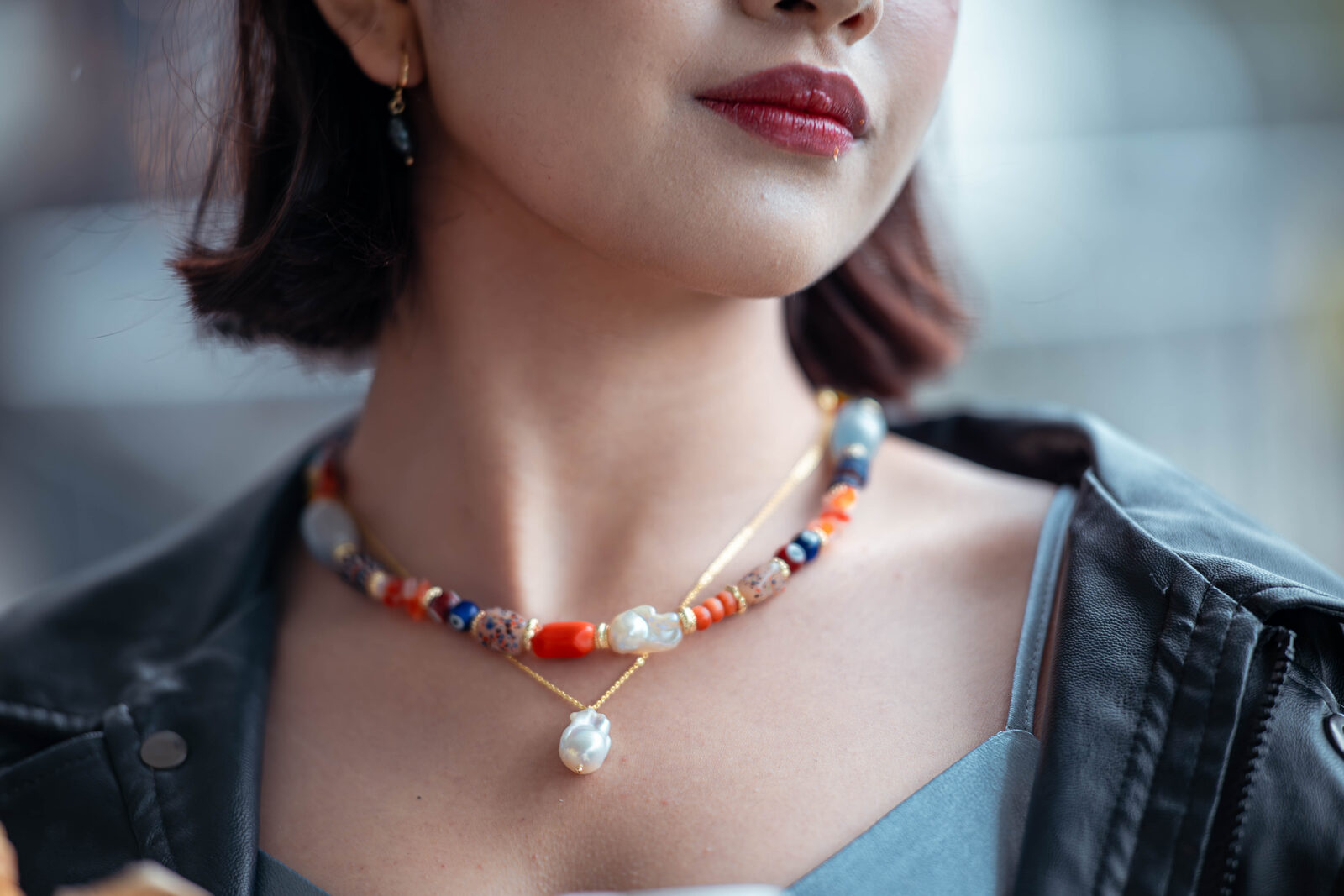
Explore by material family
Stone & beadwork
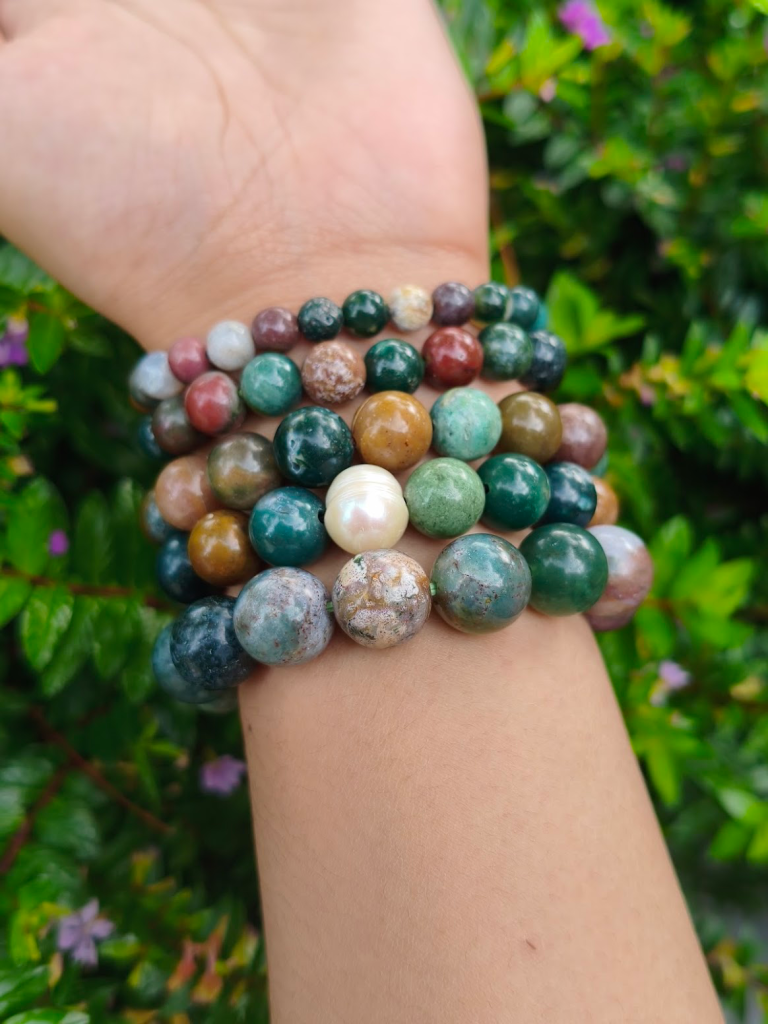
Natural stone, glass, and mixed beads arranged to keep color, translucence, pattern, and variation visible.
Pearl & organic form
Pearls and organic materials selected for their individual shape, surface, and quiet irregularity.
Fiber & carried objects
Textile, woven accents, and carried pieces where utility, movement, and personal story meet.
Metal & setting details
Hooks, wirework, chains, clasps, and settings chosen to support the material rather than overpower it.
See the pieces. Find your story.
Browse the photographs by collection. Tap a piece to read its material story, then message us to confirm the current price, fit, and availability.
Stones & Crystals
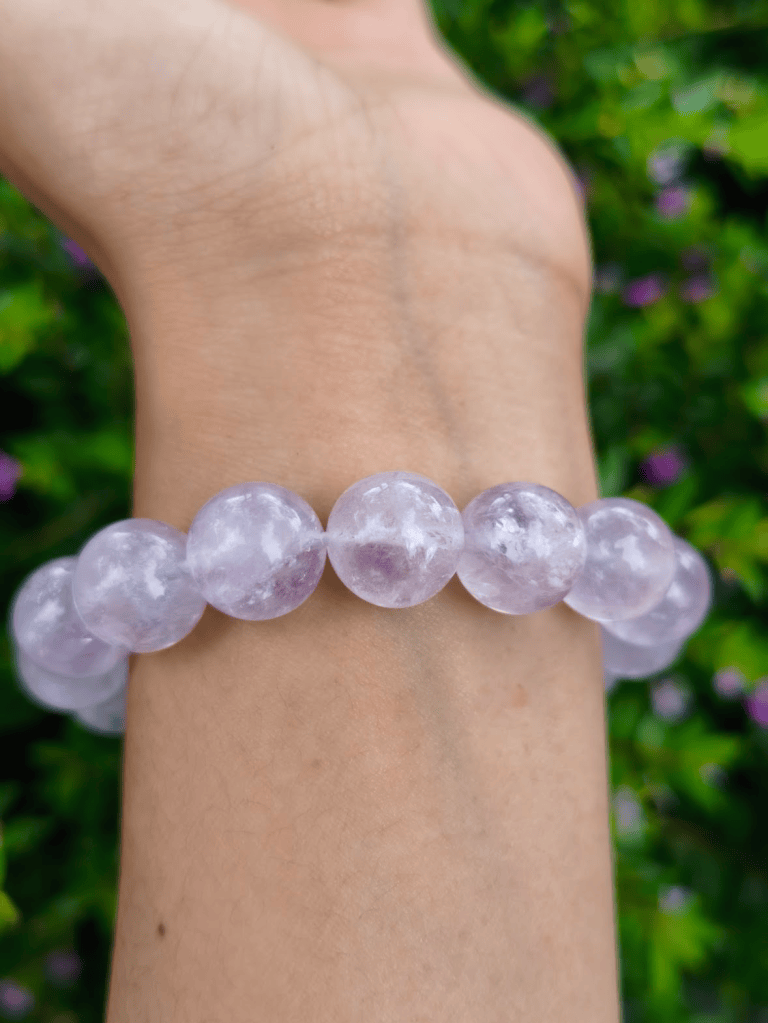
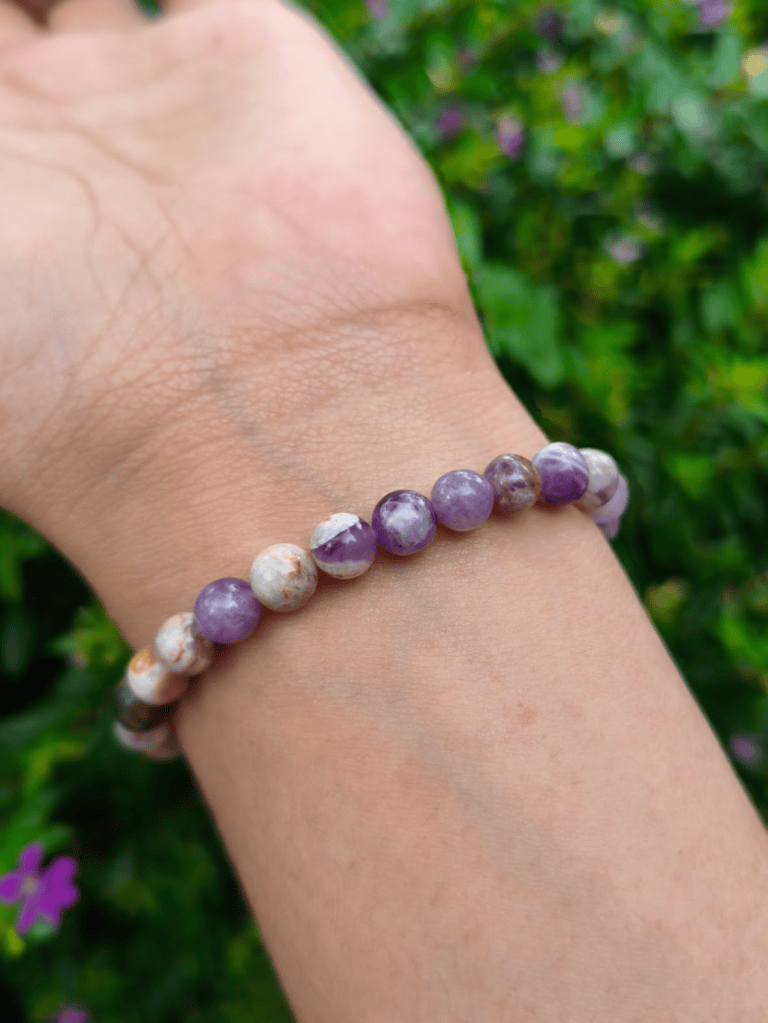
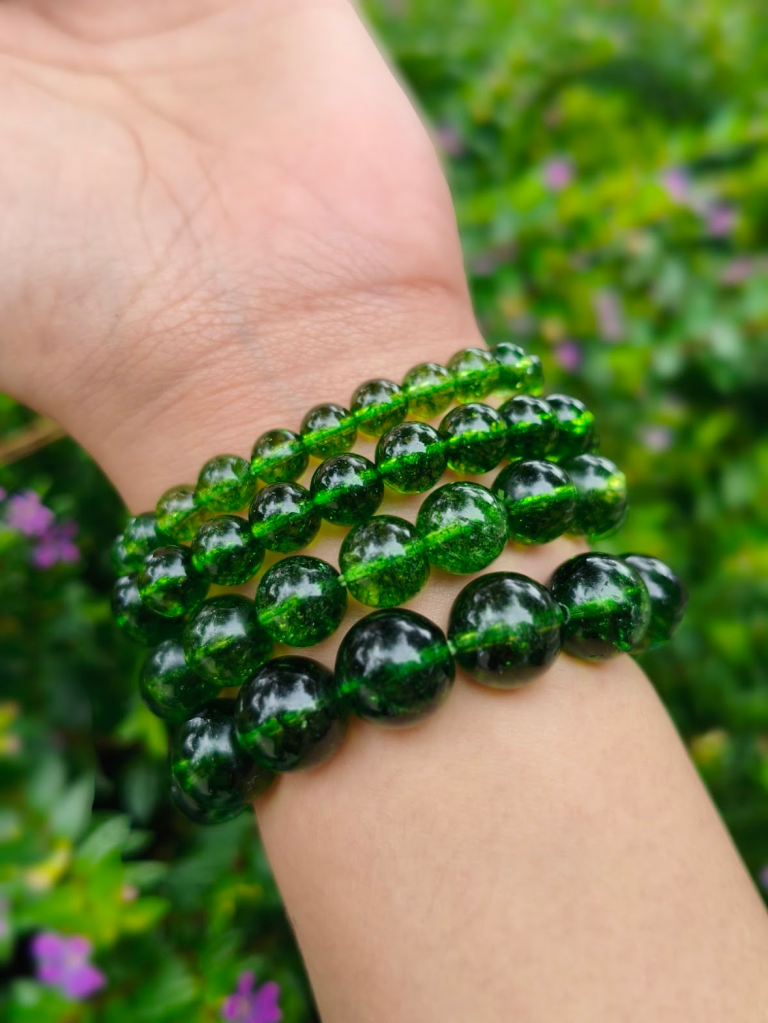
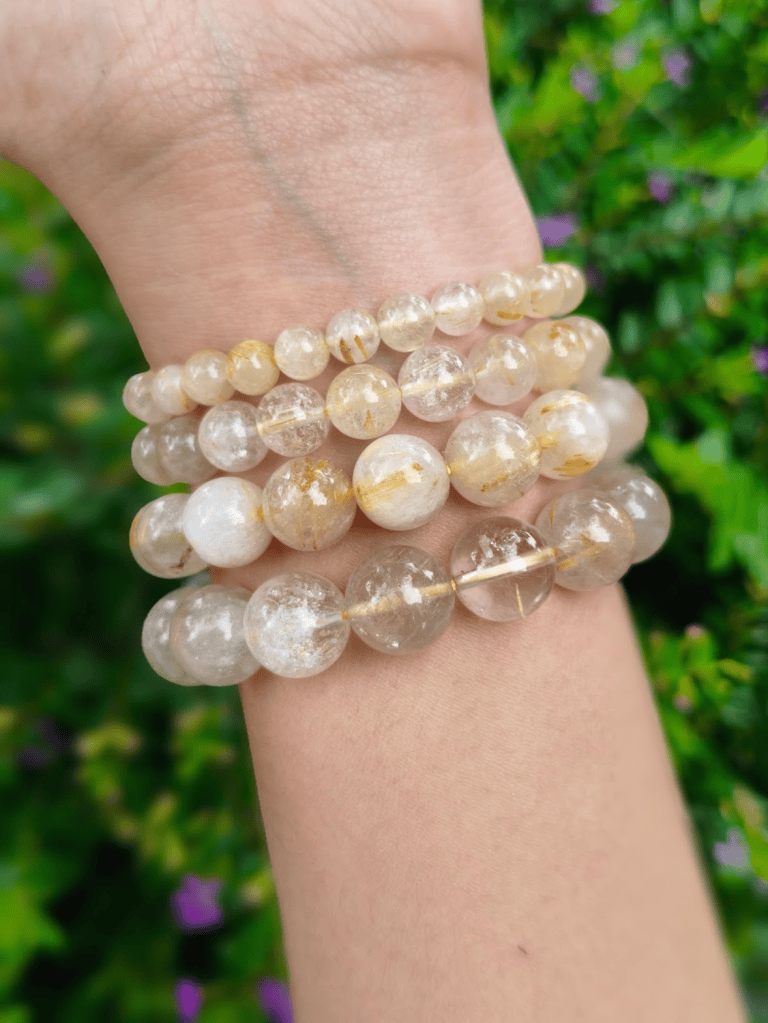
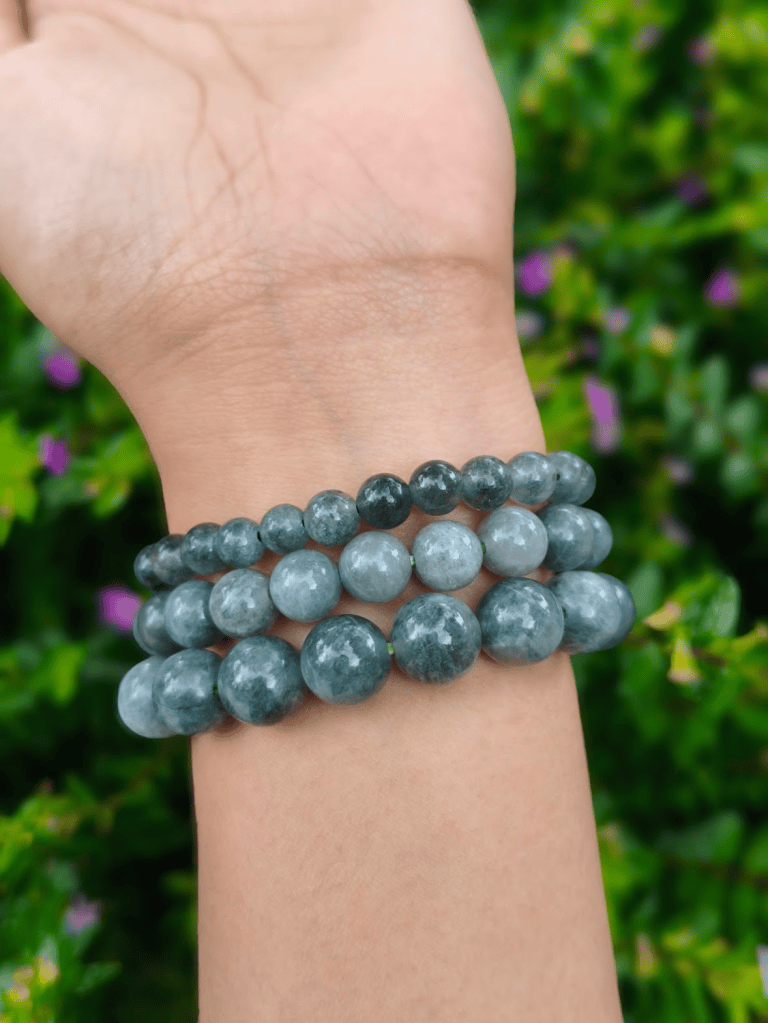
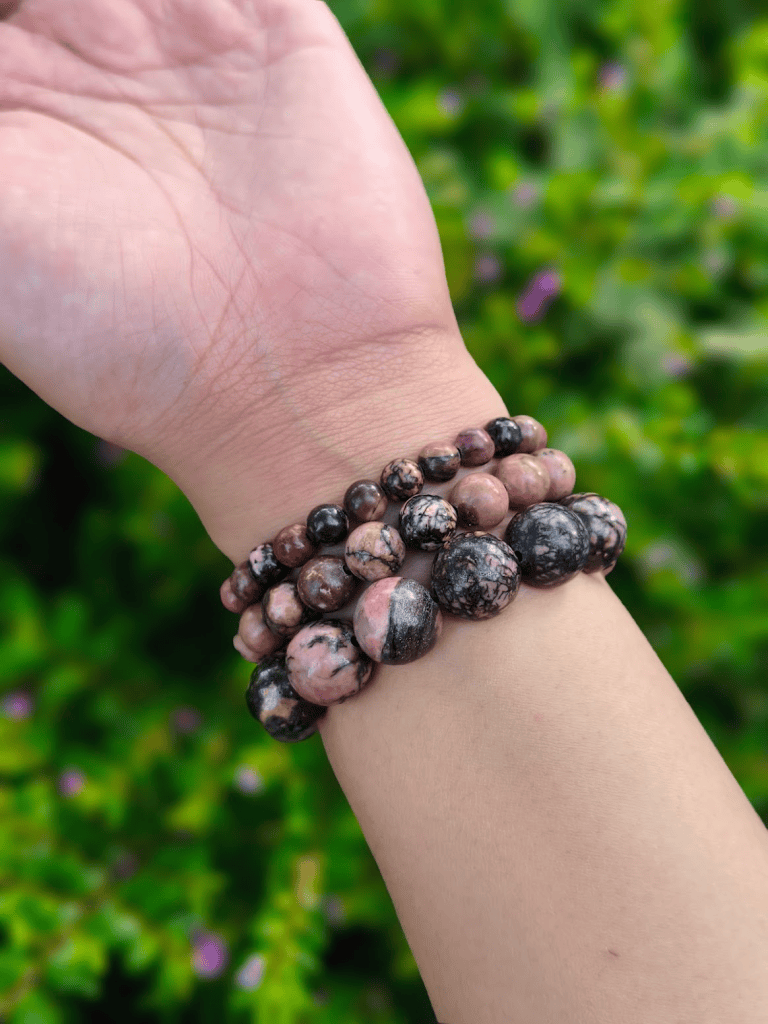
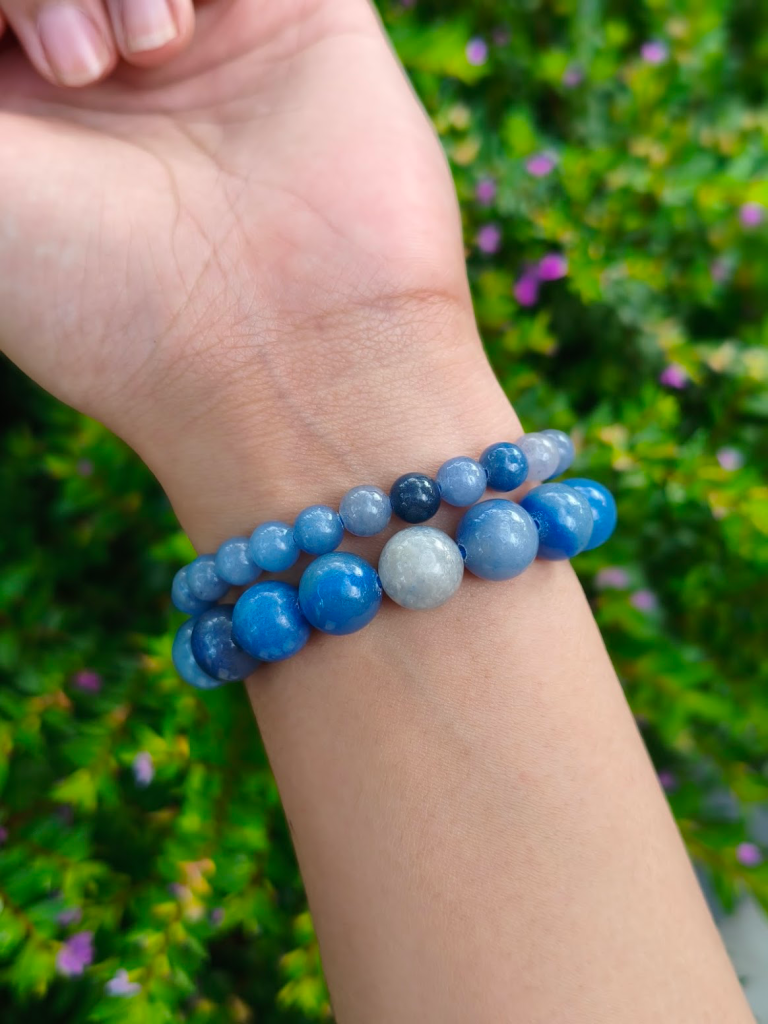
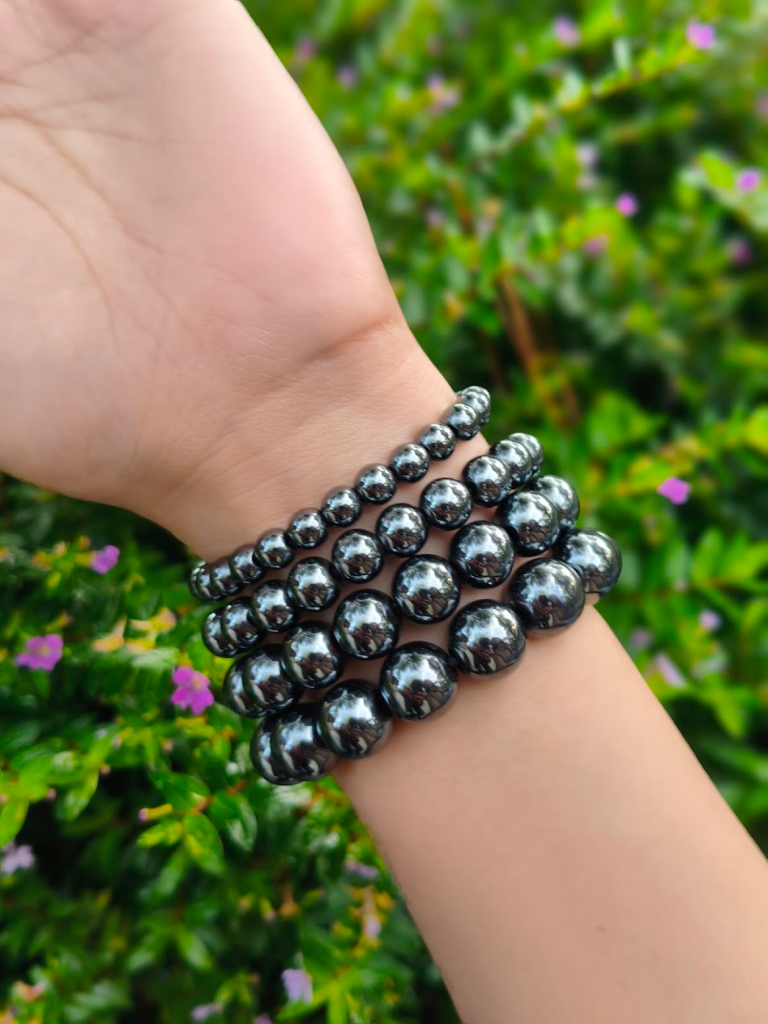
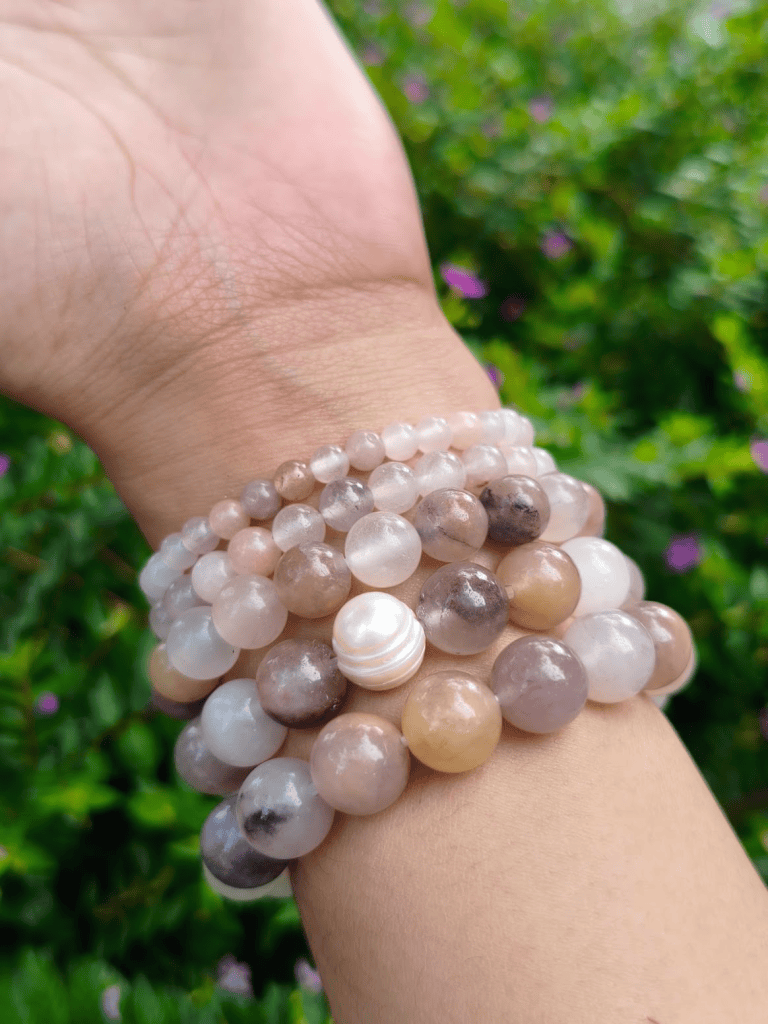
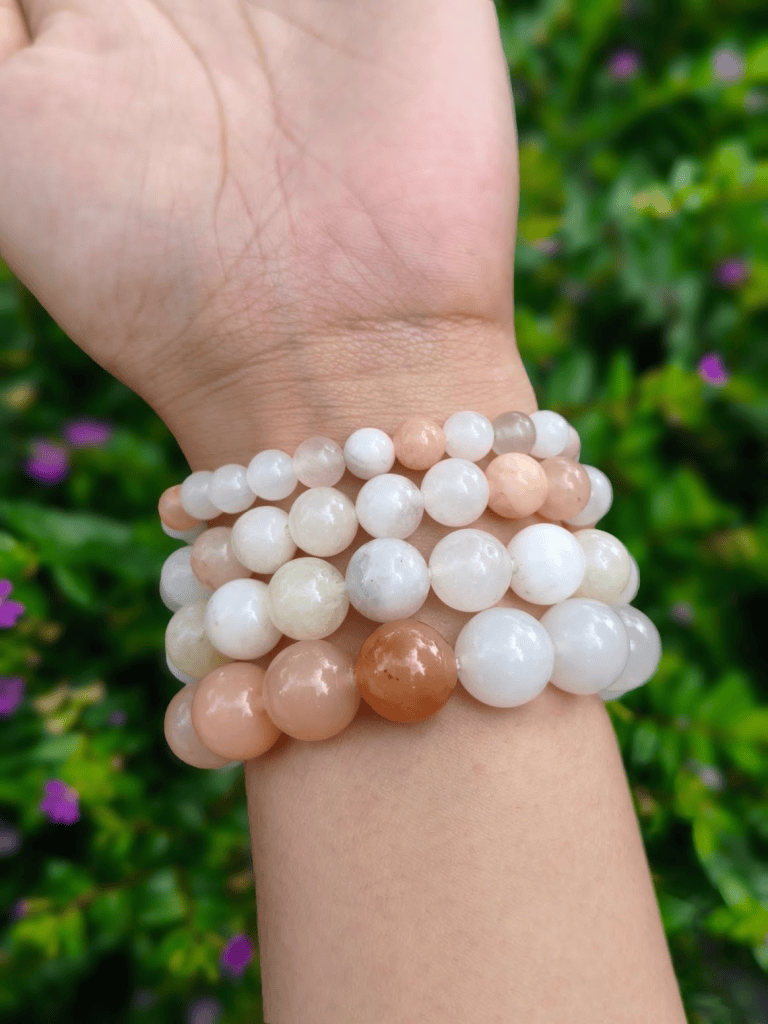
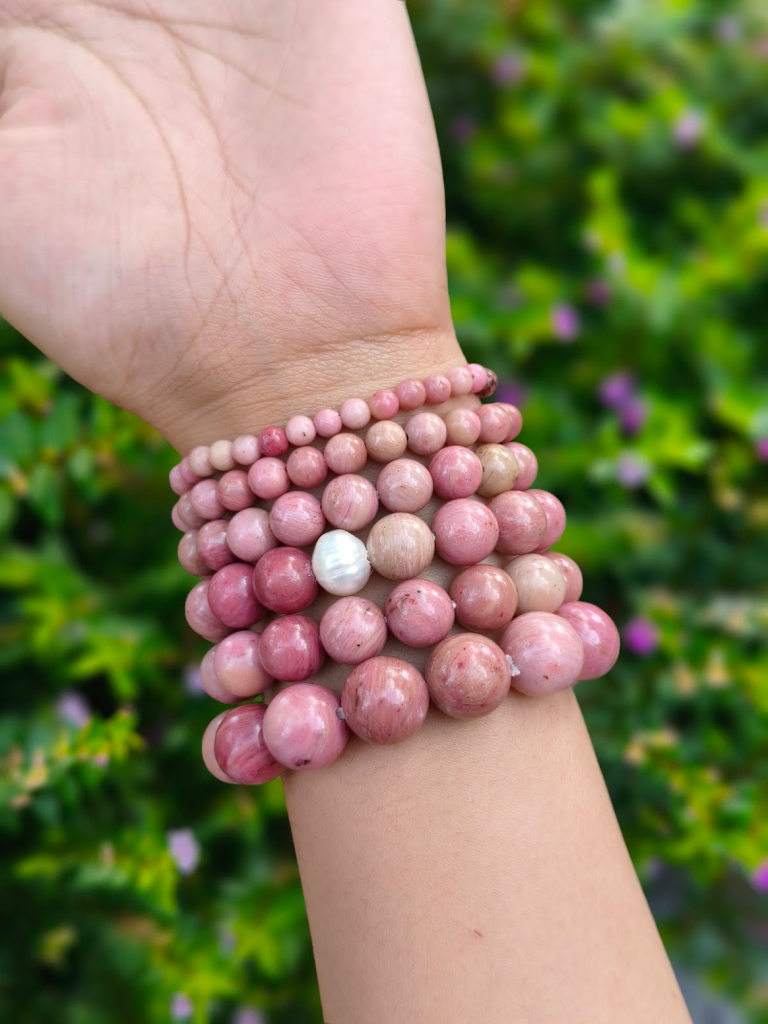
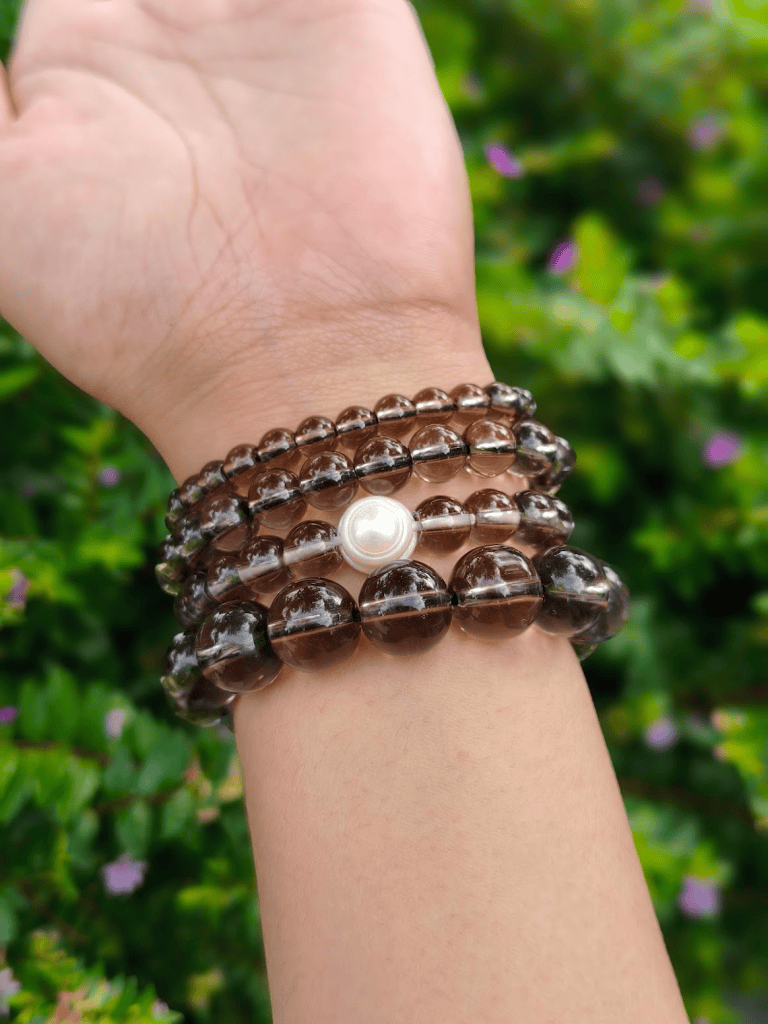
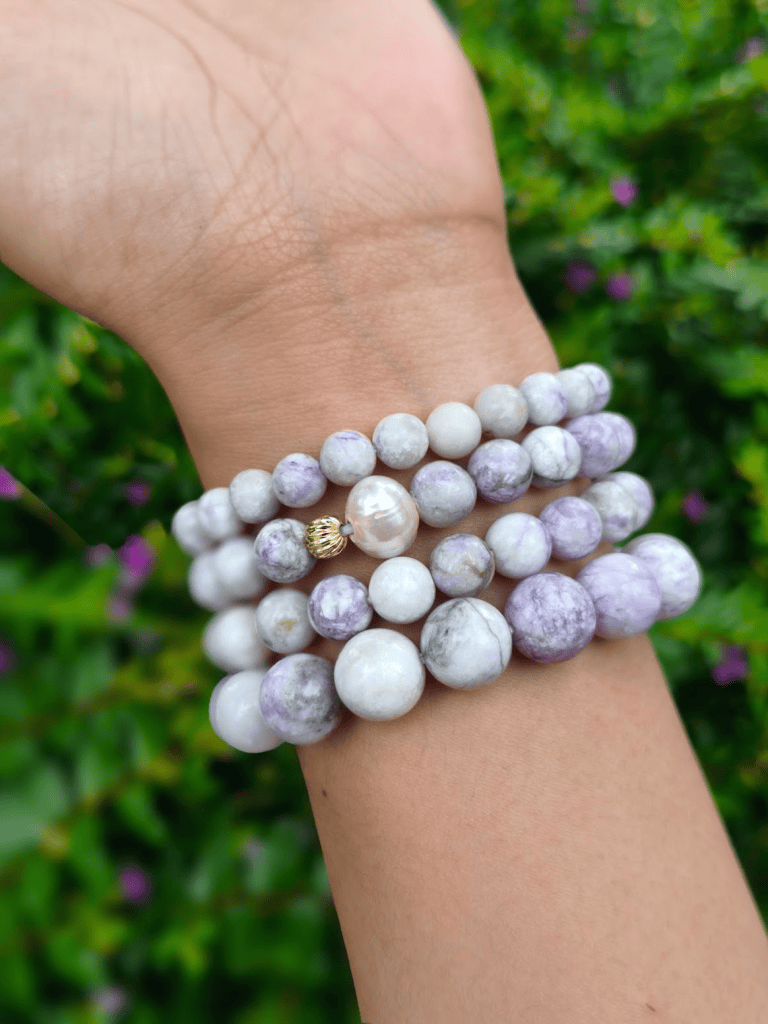
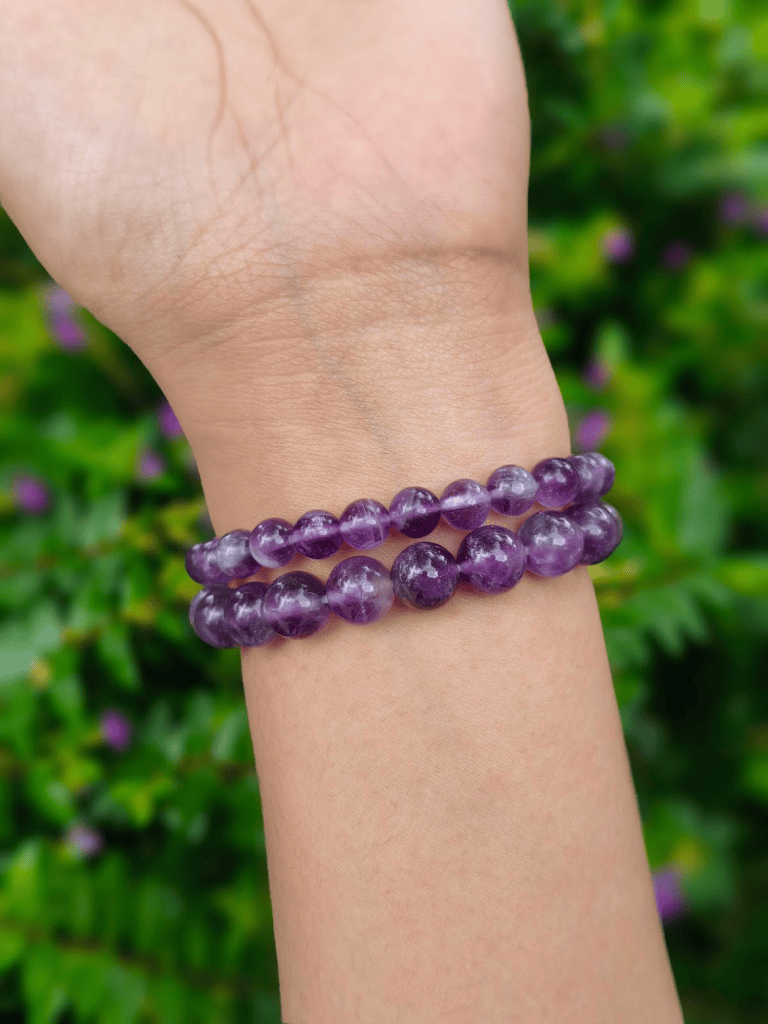
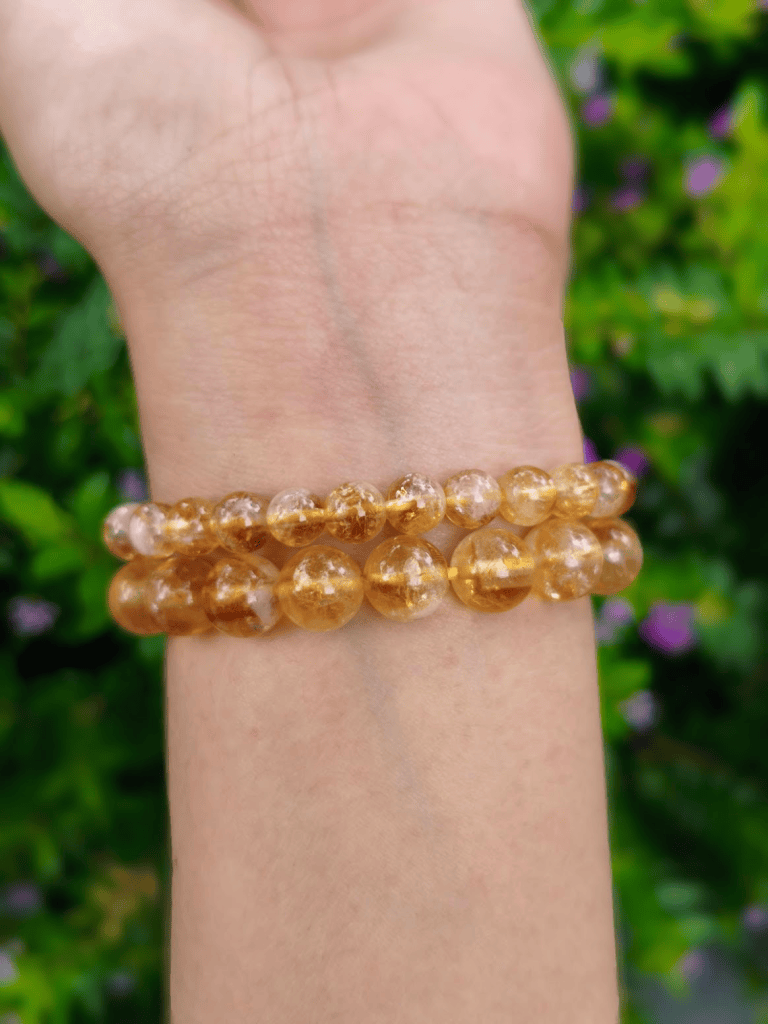
Collection One · Ancestral Threads
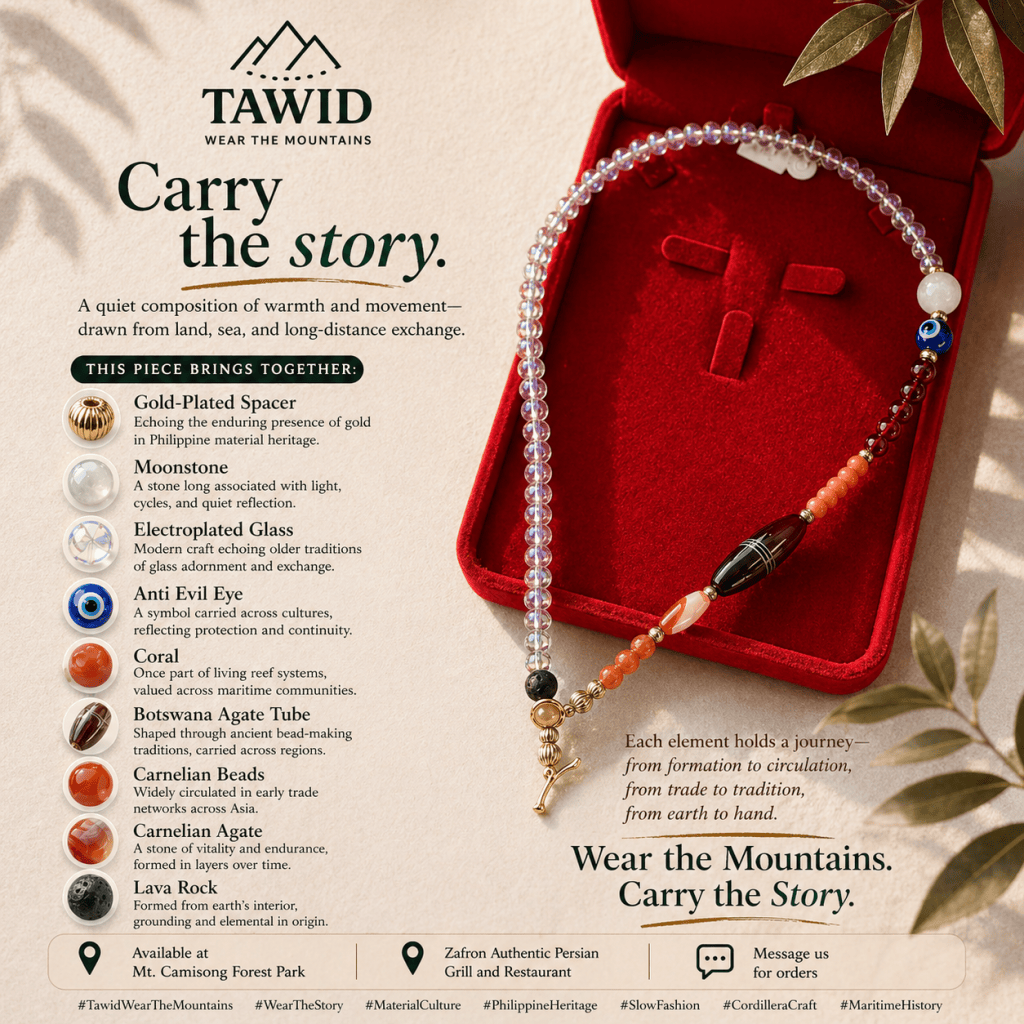
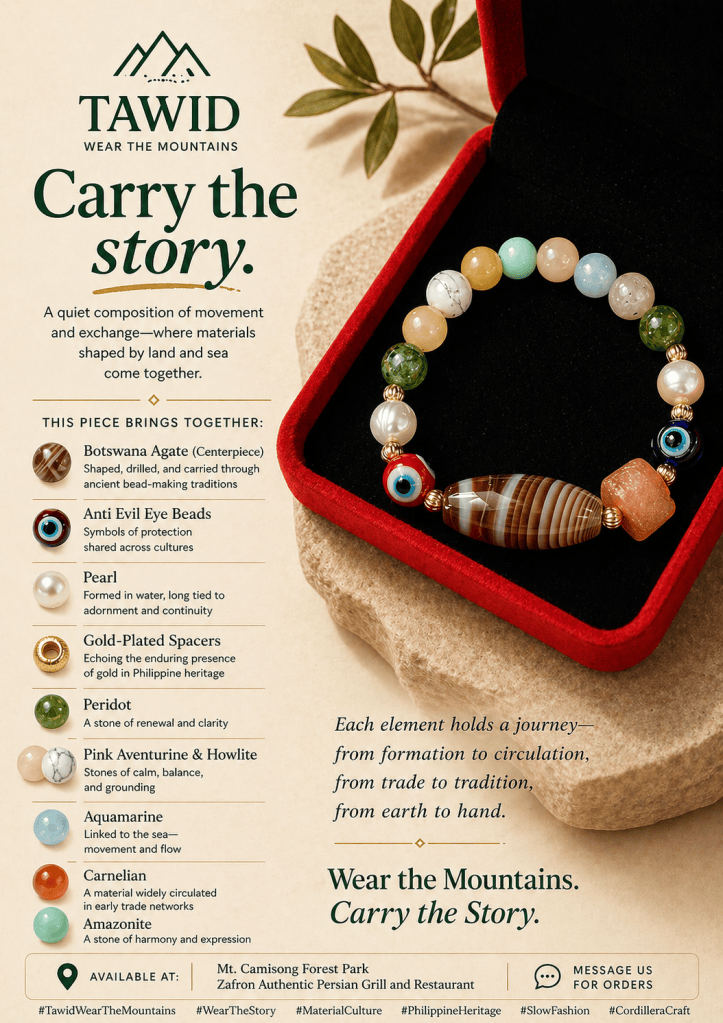
Collection Two · Katig
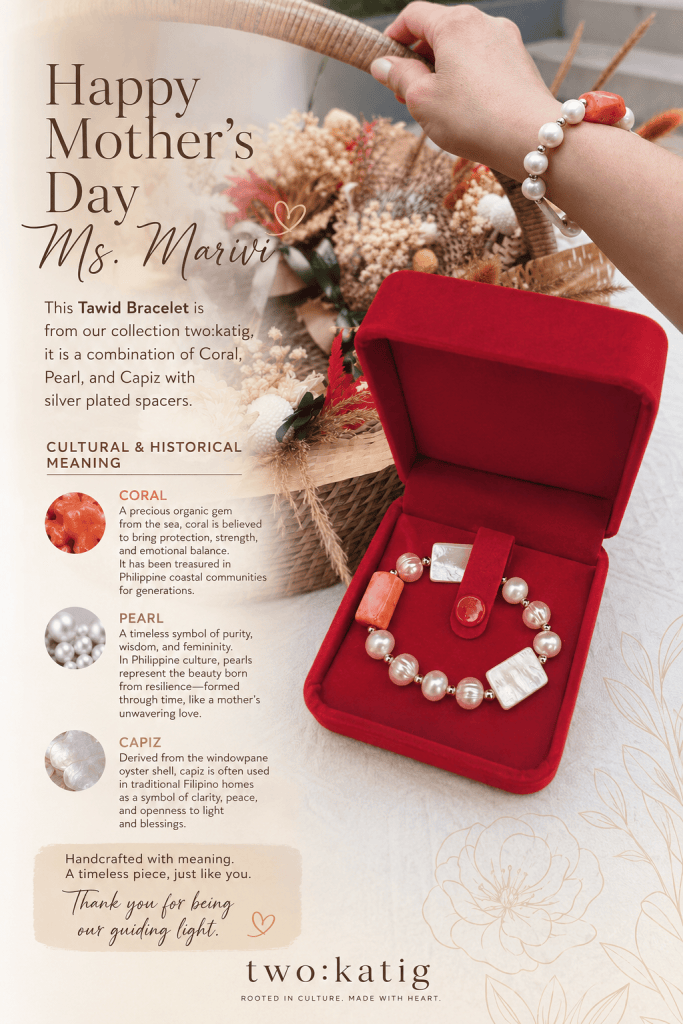
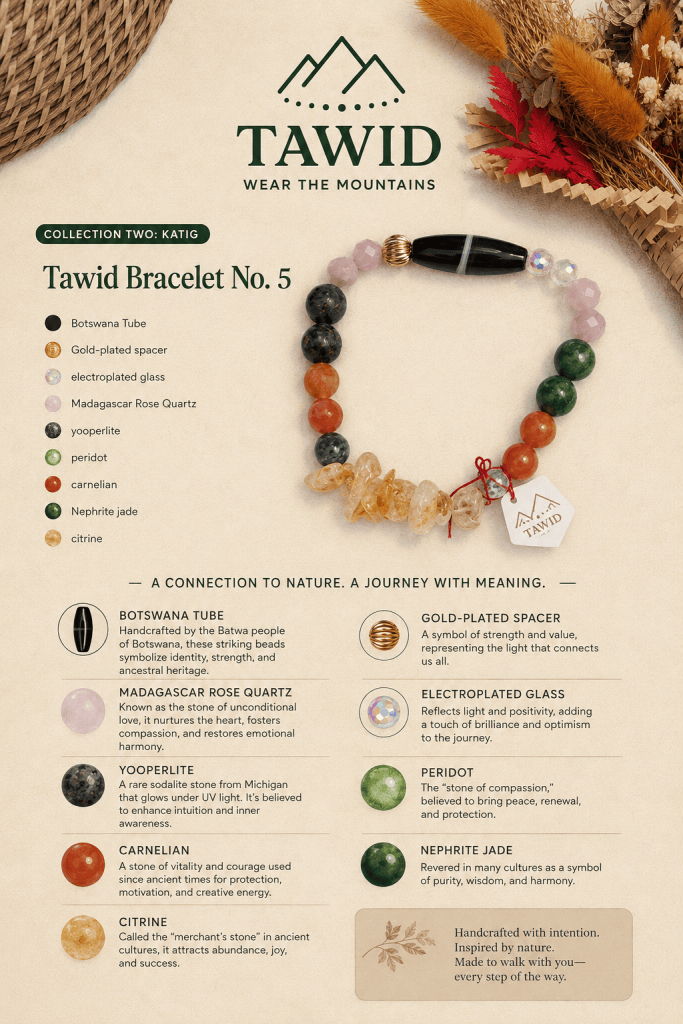
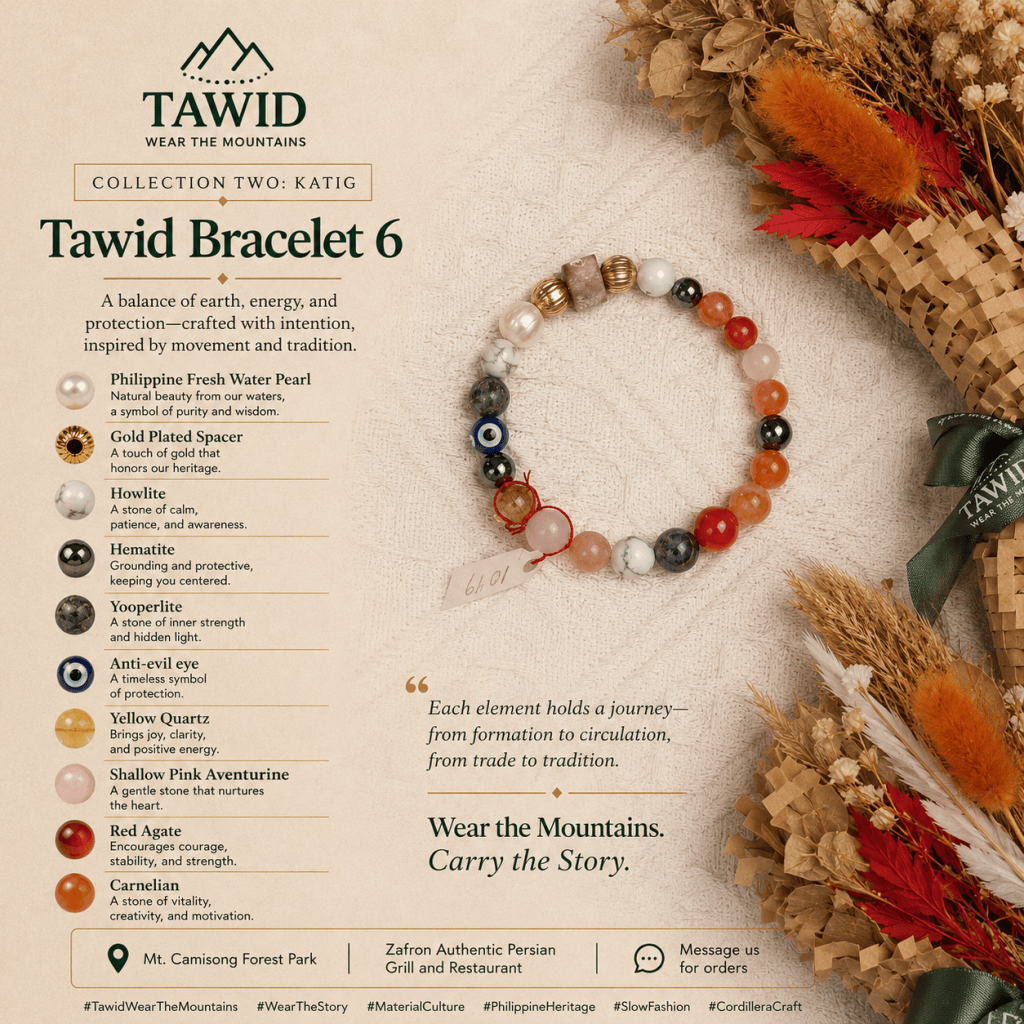
The TÁWID™ Material Library
Stones, crystals & crafted materials
Explore 61 materials carried through TÁWID™ pieces. Choose any name in the A–Z index to reach its story, origin category, and TÁWID™ interpretation.
Available bracelet collection
Prices & bead sizes
Prices are for one bracelet. Natural color, pattern, and bead variation make every piece unique. Final availability and fit are confirmed through Message to Order.
14 mm or 16 mm: Rhodochrosite, Golden Obsidian, and Silver Sheen Obsidian only.
Currently priced materials
Microcrystalline Quartz (Chalcedony)
Agate (General Varieties)
Read the material story
Agate has been used since the Neolithic period for beads, seals, and carved amulets due to its durability and distinctive banding. Major production centers in the Indus Valley Civilization demonstrate advanced bead-drilling technology as early as 2500 BCE, and agate circulated widely through Indian Ocean maritime trade networks. Archaeological evidence from Philippine sites such as Butuan confirms the presence of imported chalcedony beads consistent with agate varieties, indicating integration into precolonial exchange systems linking South Asia and Southeast Asia. Across cultures, its layered structure symbolized continuity, protection, and accumulated wisdom. Anthropologically, agate beads functioned as portable wealth and identity markers within trade-based societies.
In TÁWID™: agate represents layered identity shaped by movement, memory, and ancestral exchange.
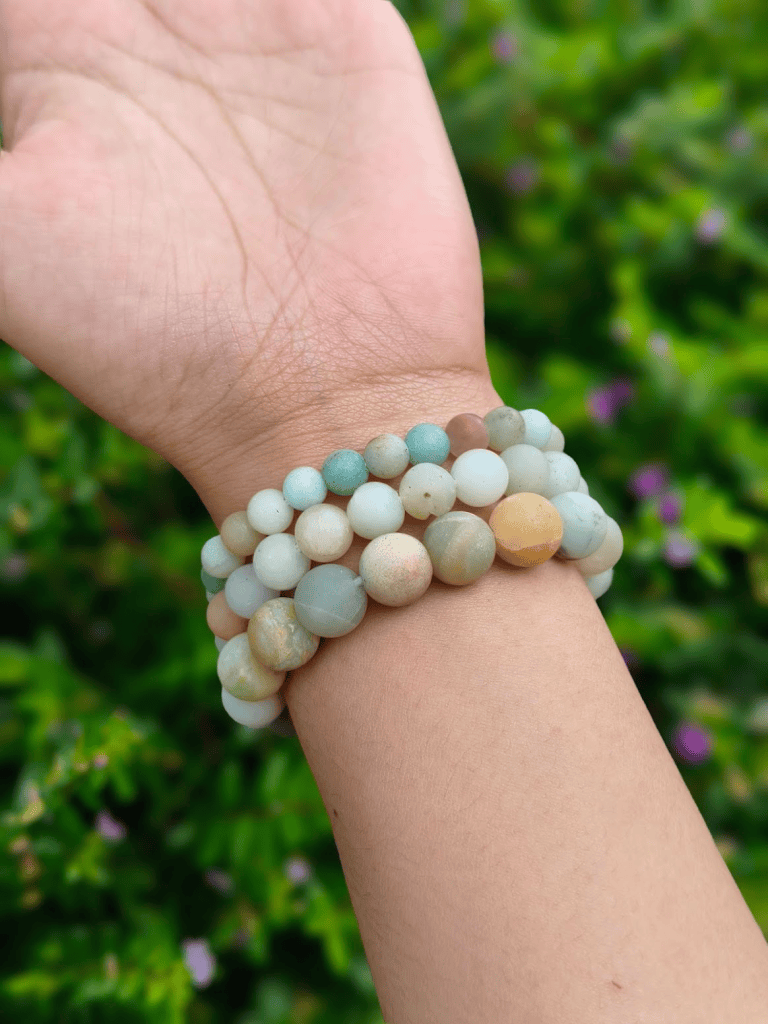
Crystalline Mineral (Feldspar – Microcline)
Amazonite
Read the material story
Amazonite was used in ancient Egypt and Mesopotamia for ornamental inlays and small carved objects, though its name is a geographic misattribution. Its green coloration led to later symbolic associations with composure and balance in European mineral lore. Unlike agate and carnelian, amazonite was not a dominant Indo-Pacific trade bead and does not appear prominently in Philippine archaeological assemblages. Its modern presence reflects global mineral circulation rather than Austronesian maritime exchange. Anthropologically, it demonstrates how aesthetic appeal can outlast limited historical trade footprint.
In TÁWID™: amazonite signifies calm discernment carried within contemporary global interconnectedness.
Crystalline Mineral (Quartz)
Amethyst
Read the material story
Amethyst was valued in Greek and Roman societies for engraved gems and elite adornment, symbolizing restraint and clarity. In medieval Europe, it became associated with ecclesiastical authority and moral discipline, worn by bishops as a sign of humility. Before Brazilian discoveries in the 19th century expanded supply, it was classified among precious gemstones. Quartz deposits occur in parts of the Philippines, though amethyst is not prominently documented in precolonial bead contexts. Its changing economic status demonstrates how geological discovery reshapes social hierarchy around materials.
In TÁWID™: amethyst represents disciplined wisdom shaped by access, knowledge, and historical transformation.
Crystalline Mineral (Calcium Sulfate – Evaporite Mineral)
Angelite (Anhydrite)
Read the material story
Angelite is the trade name for blue anhydrite, historically used more in sculpture and industrial contexts than bead production. Its softness limits durability compared to chalcedony or jade, making it less common in ancient long-distance trade systems. There is no documented evidence of angelite in Indo-Pacific maritime exchange networks or precolonial Philippine archaeological sites. Its symbolic associations are largely contemporary and market-driven. Anthropologically, it reflects modern mineral appreciation rather than ancient craft specialization.
In TÁWID™: angelite represents contemporary material culture integrated into a heritage-rooted framework.
Man-Made Glass Material
Anti-Evil Eye / Nazar / Mati (Glass Bead)
Read the material story
The evil eye bead originated in Mediterranean and West Asian traditions as a protective symbol against envy and harm. Through Ottoman and later global trade networks, its form spread widely across regions, including Southeast Asia in modern periods. While glass beads appear in Philippine archaeological contexts—especially during colonial exchange—the Nazar design itself is a more recent cultural import. It reflects the universal human concern with protection and vigilance expressed through ornament. Anthropologically, it demonstrates symbolic migration across cultures.
In TÁWID™: it represents watchfulness grounded in intention rather than fear.
Crystalline Mineral (Quartz with Fuchsite Inclusions)
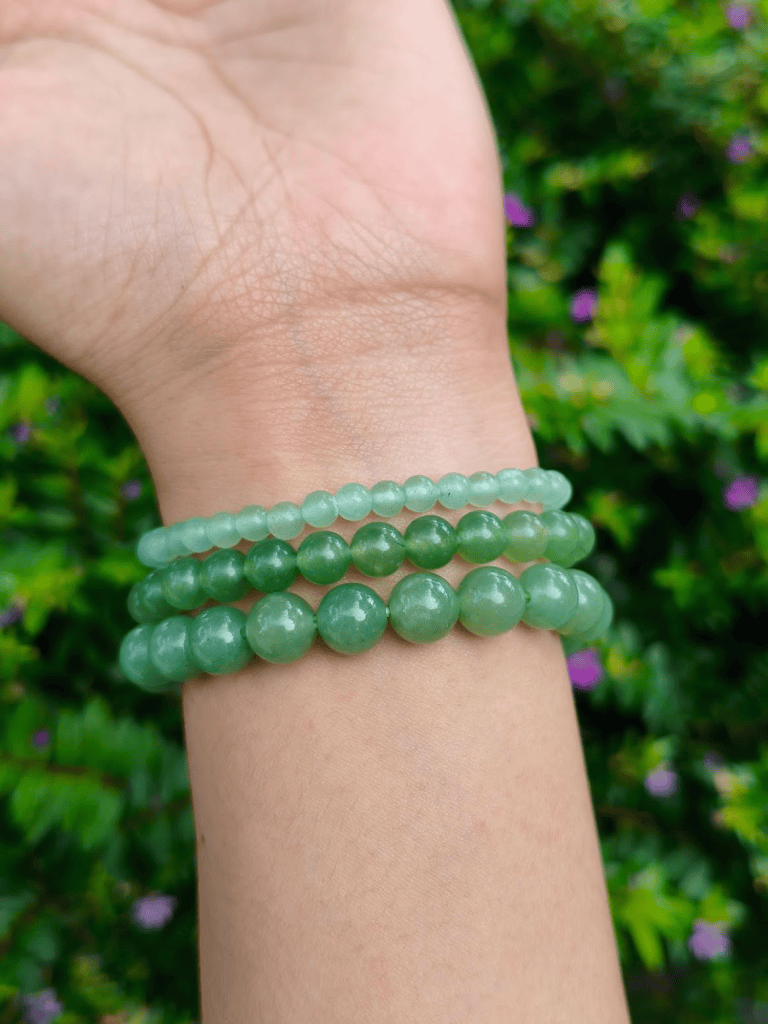
Aventurine
Read the material story
Aventurine is a quartz variety characterized by shimmering inclusions of fuchsite mica. It has been used in Asian ornamental carvings and beads, though it was not a major Indo-Pacific maritime trade stone. Its green hue historically invited symbolic interpretations tied to fertility and renewal through color association. There is limited archaeological evidence of aventurine in Philippine precolonial contexts. Anthropologically, it reflects aesthetic appreciation rather than exchange dominance.
In TÁWID™: aventurine signifies gradual growth cultivated through patience and continuity.
Microcrystalline Quartz (Chalcedony)
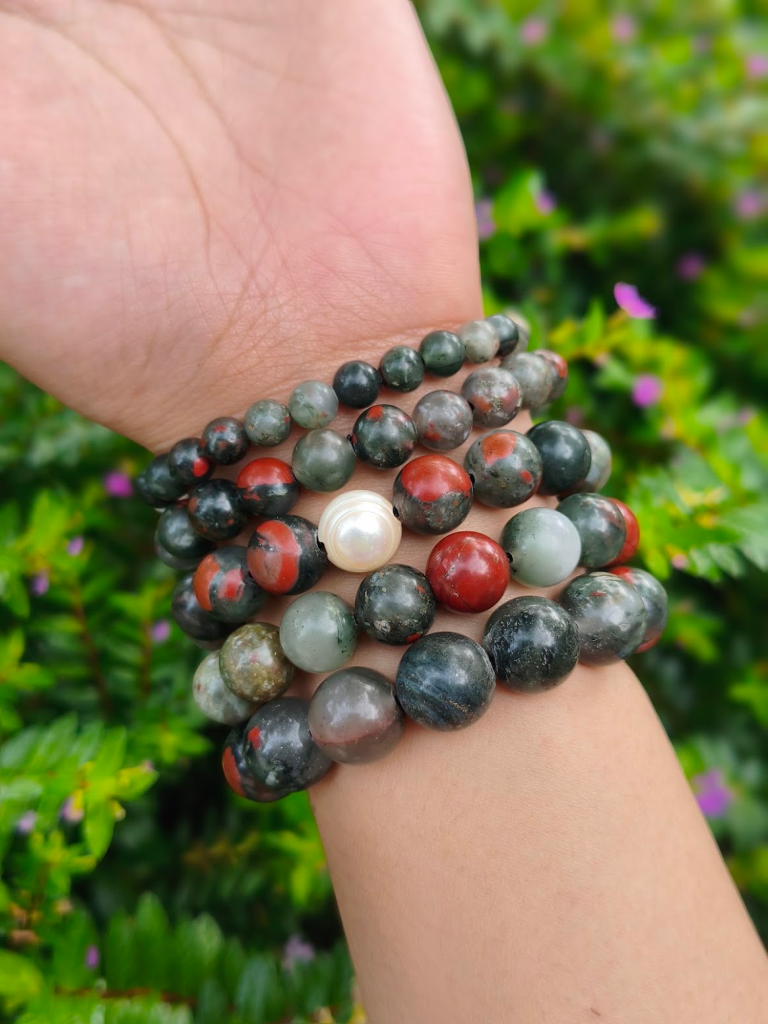
Bloodstone (Heliotrope)
Read the material story
Bloodstone was carved into Roman signet rings and later Christian devotional objects, where its red inclusions were symbolically associated with sacrifice. It demonstrates how materials can be reinterpreted across religious transitions without changing physical form. It was not a dominant Indo-Pacific trade bead and does not appear prominently in Philippine archaeological records. Its symbolic meaning evolved through cultural reinterpretation rather than geographic trade expansion. Anthropologically, it reflects continuity through symbolic adaptation.
In TÁWID™: bloodstone represents resilience shaped by trial and renewal.
Man-Made Glass with Metallic Inclusions
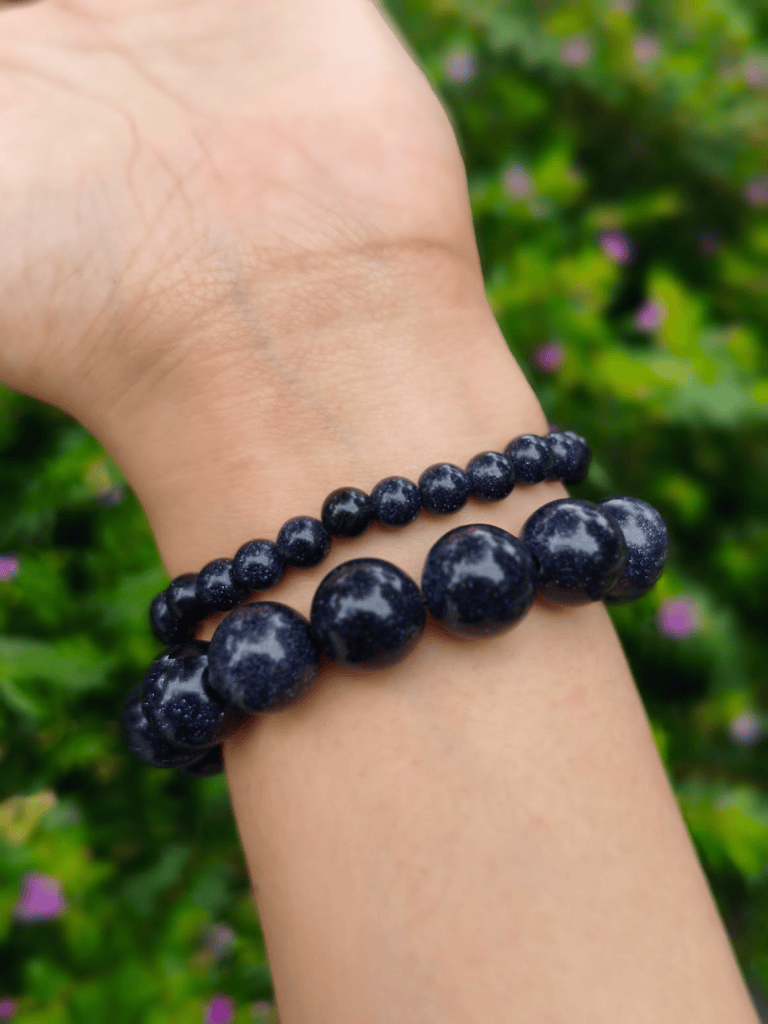
Blue Sandstone (Blue Goldstone)
Read the material story
Blue sandstone, also known as blue goldstone, originated in 17th-century Venetian glassmaking as a copper-infused invention. It reflects early modern European experimentation in decorative glass production. It has no ancient Indo-Pacific trade record and is not archaeologically present in precolonial Philippine contexts. Its metallic sparkle mimics celestial imagery, contributing to its symbolic interpretation in modern use. Anthropologically, it represents technological ingenuity in material craft.
In TÁWID™: blue sandstone signifies human creativity transforming base material into light-bearing form.
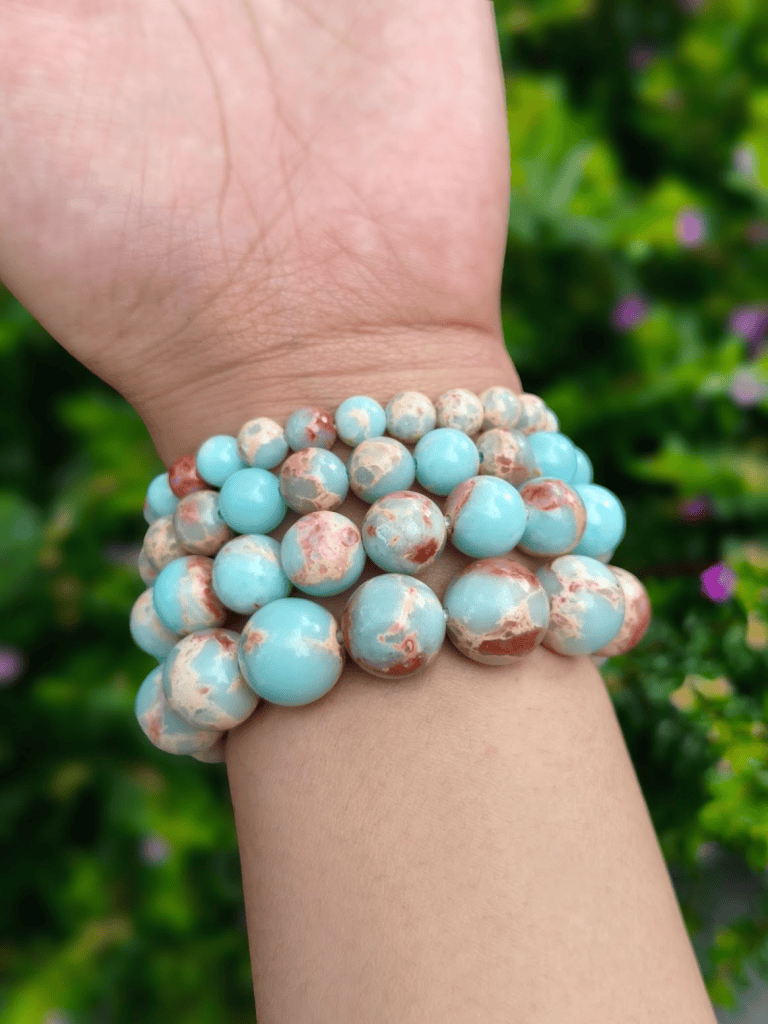
Microcrystalline Quartz (Jasper; often color-enhanced)
Blue Snakeskin Jasper
Read the material story
Blue snakeskin jasper is a patterned jasper variety, sometimes enhanced to intensify color. Jasper has ancient use in Egyptian scarabs and Mesopotamian seals due to its hardness and engraving suitability. It was not a dominant Indo-Pacific maritime trade stone compared to carnelian. There is no specific archaeological record of snakeskin jasper in Philippine contexts, though jasper as a broader material circulated regionally. Anthropologically, patterned stones often attracted symbolic interpretation based on natural markings.
In TÁWID™: snakeskin jasper represents vigilance and renewal through adaptation.
Microcrystalline Quartz (Banded Chalcedony)
Botswana Agate
Read the material story
Botswana agate entered global gemstone markets primarily during colonial and postcolonial mineral extraction in southern Africa. While agate itself has deep antiquity, this specific geographic designation reflects modern trade systems. It was not a primary Indo-Pacific maritime trade bead and does not appear in documented Philippine archaeological assemblages. Its banded patterns historically symbolized continuity in broader agate traditions. Anthropologically, it demonstrates how geographic branding shapes contemporary mineral identity.
In TÁWID™: Botswana agate represents global interconnectedness integrated into local narrative.
Quartz Variety
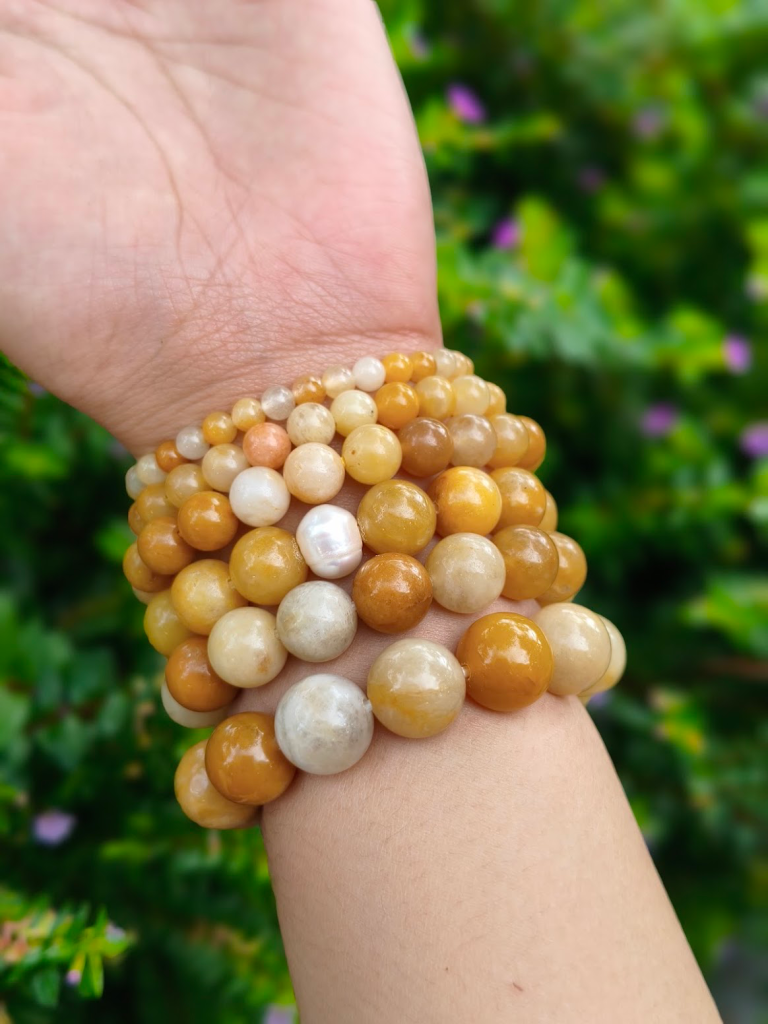
Butter Quartz
Read the material story
Butter quartz is a descriptive trade name referring to pale yellow quartz with soft, creamy coloration. Quartz is one of the most abundant minerals in the Earth’s crust and has been used in ornamentation across cultures for millennia. Variations in trace minerals or inclusions can produce subtle color differences, giving rise to informal trade names such as butter quartz. While not historically classified as a major prestige gemstone, its visual warmth makes it a favored material in contemporary beadwork.
In TÁWID™: butter quartz represents warmth, balance, and the quiet richness of common minerals shaped into adornment.
Microcrystalline Quartz (Chalcedony)
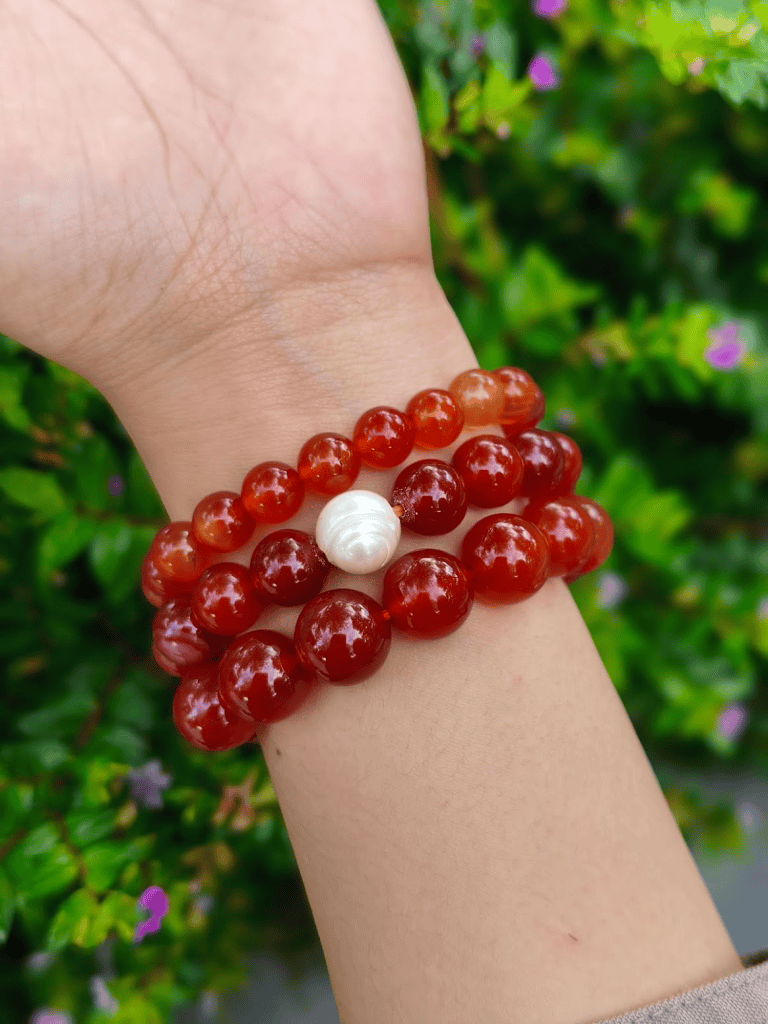
Carnelian
Read the material story
Carnelian was extensively produced in Gujarat and exported through Indian Ocean trade networks beginning around 2500 BCE. Its heat-treated enhancement demonstrates advanced early mineral technology. Carnelian beads have been excavated in Philippine sites such as Butuan, confirming precolonial maritime exchange connections. It symbolized vitality and authority in multiple ancient civilizations. Anthropologically, it is one of the clearest material indicators of long-distance Indo-Pacific trade.
In TÁWID™: carnelian represents movement anchored in ancestral continuity.
Microcrystalline Quartz
Chalcedony (General)
Read the material story
Chalcedony encompasses agate, carnelian, and related fine-grained quartz varieties used globally in bead and seal production. It circulated widely into Southeast Asia through Indian Ocean trade networks. Philippine burial sites include chalcedony beads consistent with imported trade goods. Its durability made it suitable for portable wealth in maritime societies. Anthropologically, it reflects early craft specialization and exchange systems.
In TÁWID™: chalcedony represents quiet resilience within movement.
Man-Made Glass (Synthetic Quartz Imitation)
Cherry Quartz
Read the material story
Cherry quartz is a synthetic glass created to resemble natural quartz varieties. It reflects modern gemstone manufacturing rather than ancient trade systems. It has no archaeological presence in precolonial Philippine contexts. Its production demonstrates technological control over color and clarity. Anthropologically, it illustrates the distinction between natural mineral heritage and contemporary craft innovation.
In TÁWID™: it represents transparency about origin and adaptation within modern material culture.
Historical Glass Beads (Multi-Layered Glass)
Chevron Beads
Read the material story
Chevron beads are layered glass beads historically produced in Venice, particularly on the island of Murano from the late medieval period onward. Their distinctive star or striped pattern results from multiple colored glass layers cut to reveal geometric designs. Venetian chevrons circulated globally through maritime trade and later became widely known as trade beads. These beads demonstrate the role of specialized glassmaking centers in early global exchange networks.
In TÁWID™: chevron beads represent layered histories of craftsmanship, commerce, and intercultural movement.
Crystalline Mineral (Quartz; often heat-treated amethyst in commercial trade)
Citrine
Read the material story
Citrine is a yellow to golden variety of quartz, historically rare in natural form and valued in Roman antiquity for intaglios and ornamental jewelry. In the 18th–19th centuries, Scottish weapon handles (sgian-dubh and kilt pins) frequently featured citrine, linking it to Highland identity and craftsmanship. Much of the citrine in global markets today is heat-treated amethyst, reflecting evolving gemstone technologies and commercial adaptation. While citrine has no direct archaeological evidence in precolonial Philippine bead assemblages, yellow and amber-toned beads circulated through Asian maritime trade networks and symbolized status and vitality in many cultures. Anthropologically, citrine represents how value is culturally assigned to color—golden hues often associated with prosperity, solar energy, and authority.
In TÁWID™: citrine embodies earned abundance—wealth understood not as excess, but as resilience cultivated through labor, continuity, and intergenerational stewardship.
Crystalline Mineral (Quartz – Silicon Dioxide)
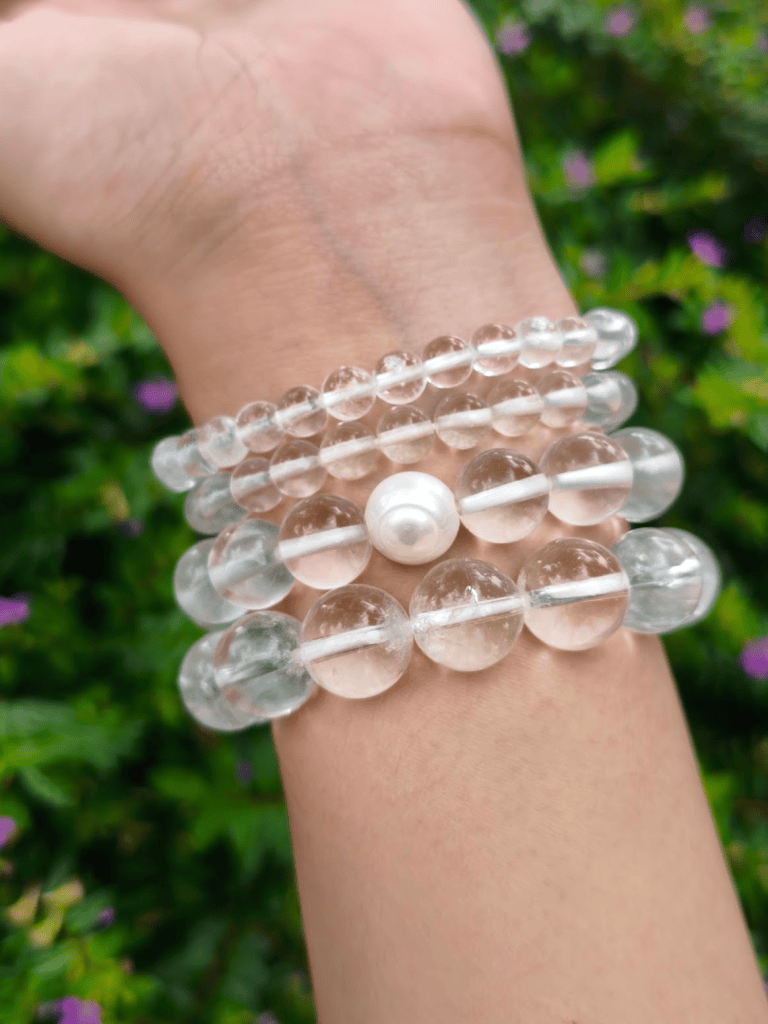
Clear Quartz
Read the material story
Clear quartz, also known as rock crystal, is one of the most abundant and widely distributed minerals on Earth, composed of silicon dioxide. It has been used since prehistoric times for tools, beads, ritual objects, and ornamentation across Asia, Europe, and the Americas. In Southeast Asia, quartz varieties circulated through regional exchange networks, though chalcedony types were more prominent in Philippine archaeological contexts than large rock crystal specimens. Its transparency and hexagonal crystal form contributed to early interpretations of purity, light, and permanence in multiple civilizations. Anthropologically, clear quartz demonstrates how optical clarity influences symbolic value beyond rarity.
In TÁWID™: clear quartz represents continuity without distortion — a vessel stone that carries memory, intention, and lineage while remaining grounded in geological truth.
Organic / Biogenic Calcium Carbonate (Marine Skeletal Material)
Coral
Read the material story
Coral is a biogenic material formed by marine polyps that secrete calcium carbonate skeletons, creating reef structures over time. Red and pink coral have been used for ornamentation since antiquity in the Mediterranean, South Asia, and East Asia, often associated with protection and maritime life. In Southeast Asia, coral circulated within Indo-Pacific trade networks and is consistent with maritime societies that valued sea-derived materials. The Philippines, as a coral-rich archipelago, has long-standing ecological and cultural relationships with reef environments, though conservation laws now regulate coral extraction. Anthropologically, coral reflects the intimate connection between coastal communities and marine ecosystems.
In TÁWID™: coral represents life sustained by water — honoring ancestral seafaring, coastal memory, and stewardship of fragile ecological inheritance.
Man-Made Glass
Fire Agate / Fire Quartz (Man-Made Glass)
Read the material story
Materials marketed as fire agate or fire quartz in beadwork are often glass designed to imitate natural mineral colors and internal reflections. These beads demonstrate modern glass technology’s ability to replicate the appearance of naturally occurring gemstones. Unlike geological minerals formed through long natural processes, glass beads are produced through controlled heating and shaping of silica-based materials. Their presence reflects contemporary craftsmanship rather than ancient geological formation.
In TÁWID™: these materials represent transparency about origin and the dialogue between natural heritage and modern creative production.
Crystalline Mineral (Silicate Mineral Group)
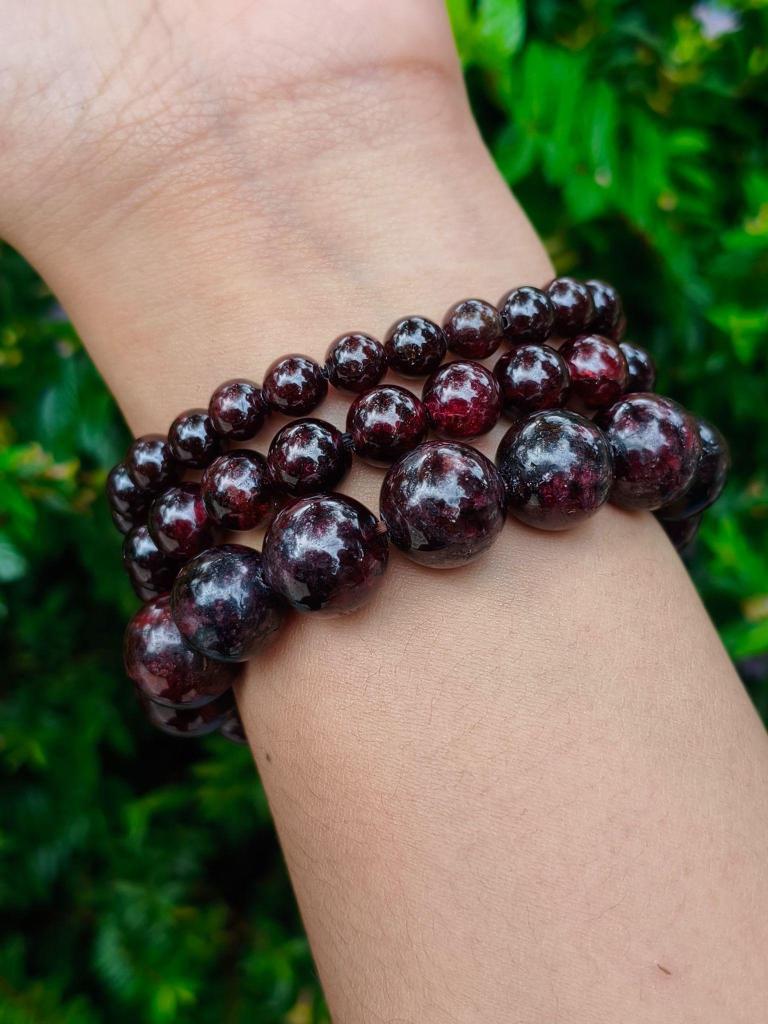
Garnet
Read the material story
Garnet has been used since the Bronze Age and appears in Egyptian, Roman, and Anglo-Saxon jewelry, often set in gold as a protective stone. Its deep red varieties were associated with vitality and safe travel across Eurasian cultures. Garnet circulated through Afro-Eurasian trade networks but was less dominant in Indo-Pacific maritime bead exchange compared to carnelian. There is limited archaeological evidence of garnet in precolonial Philippine contexts, though its presence in broader Asian trade is documented. Anthropologically, garnet reflects elite adornment and cross-continental mineral circulation.
In TÁWID™: garnet represents guarded passage and strength carried across distance.
Man-Made Glass with Copper Inclusions
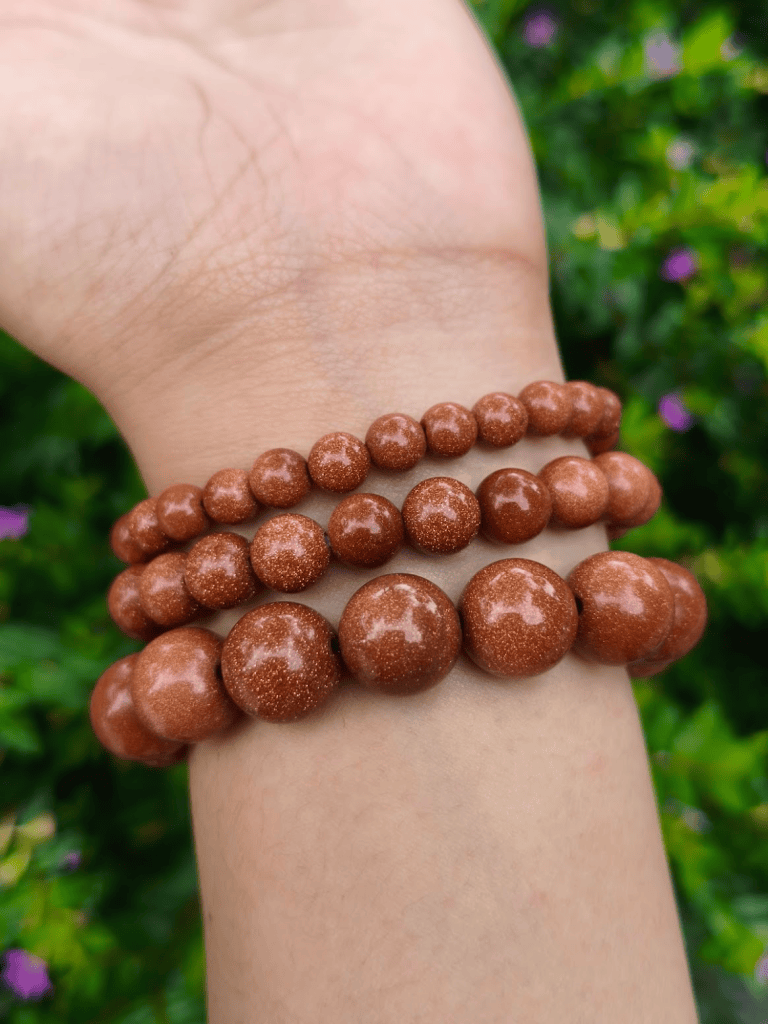
Gold Sandstone (Goldstone)
Read the material story
Goldstone originated in 17th-century Venetian glass workshops, where copper flecks were suspended in molten glass to create a metallic sparkle. It represents early European technological mastery of decorative glassmaking. It has no ancient Indo-Pacific trade history and does not appear in Philippine archaeological assemblages. Its visual resemblance to mineral ore influenced symbolic interpretations of ambition and brilliance in modern contexts. Anthropologically, it reflects innovation rather than natural geological formation.
In TÁWID™: goldstone represents crafted light born from human ingenuity.
Volcanic Glass (Amorphous Natural Glass)
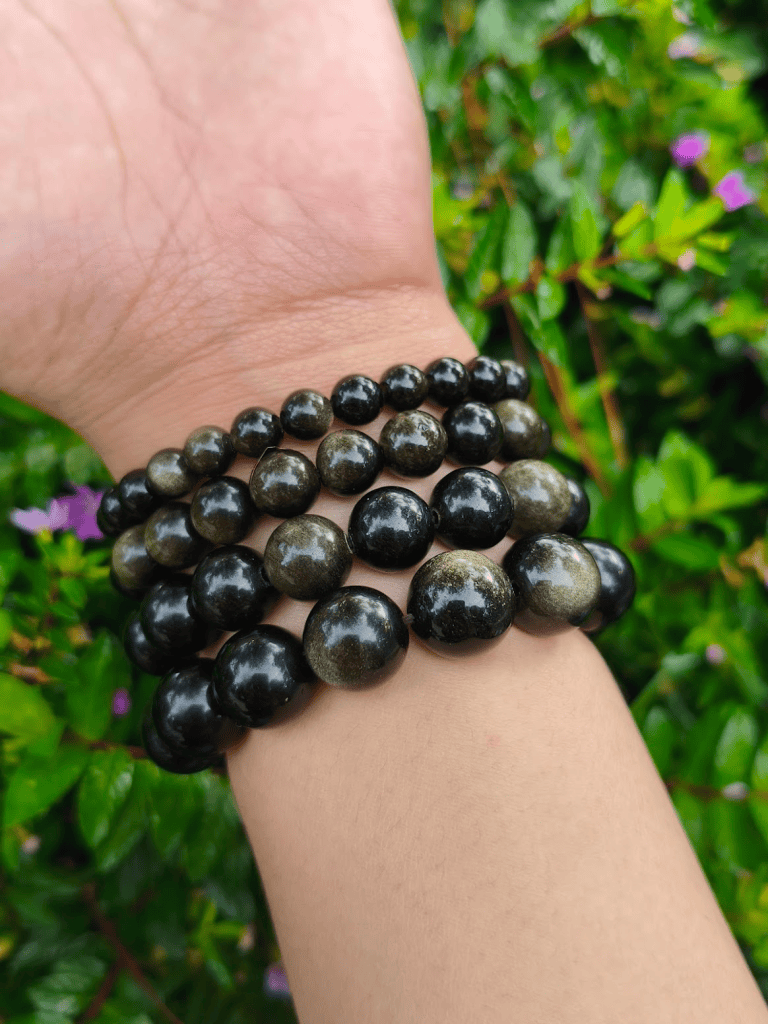
Golden Obsidian
Read the material story
Golden obsidian forms when volcanic gas bubbles align during cooling, creating a reflective sheen within natural glass. Obsidian was used globally for blades and cutting tools because of its sharp conchoidal fracture. In Southeast Asia, regional obsidian exchange networks have been documented, though the Philippines has limited natural deposits. While obsidian appears more often in tool contexts than ornamental bead trade, it represents technological sophistication in stone use. Anthropologically, it signals adaptation to volcanic landscapes.
In TÁWID™: golden obsidian symbolizes strength refined through fire and pressure.
Microcrystalline Quartz (Often Dyed Chalcedony)
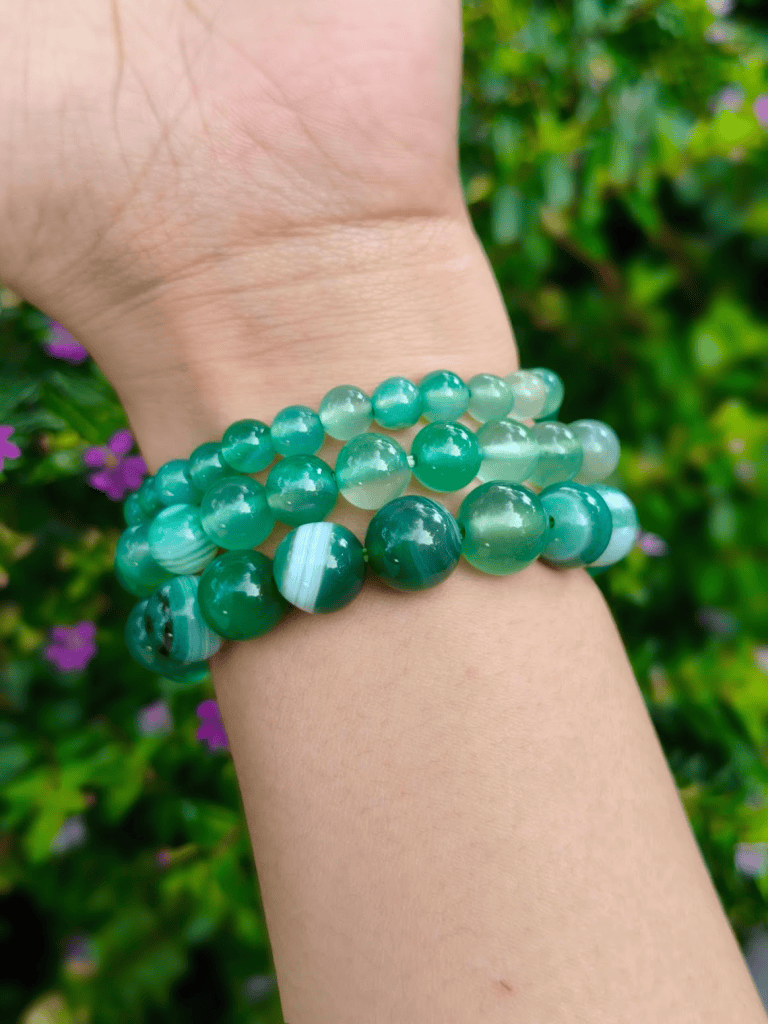
Green Agate
Read the material story
Green agate belongs to the broader chalcedony family that circulated extensively in Indo-Pacific trade networks. Many green varieties are dyed, reflecting modern gemstone enhancement practices rather than ancient coloration. Philippine archaeological sites confirm imported chalcedony beads, though specific dyed varieties are modern. Its green tone historically invited symbolic associations with renewal through color rather than mineral rarity. Anthropologically, it demonstrates how treatment alters aesthetic value without changing geological structure.
In TÁWID™: green agate represents cultivated growth layered upon inherited foundation.
Crystalline Mineral (Calcium Sulfate Dihydrate)
Gypsum
Read the material story
Gypsum has been used in architecture, carving, and plaster production since antiquity. Its softness limited its use in durable bead or seal production compared to quartz or jade. It does not appear prominently in Indo-Pacific maritime bead trade systems or Philippine archaeological contexts. Gypsum reflects structural rather than ornamental significance in ancient societies. Anthropologically, it illustrates how some minerals shaped domestic and architectural life rather than prestige exchange.
In TÁWID™: gypsum represents foundational support that often remains unseen.
Crystalline Mineral (Iron Oxide)
Hematite
Read the material story
Hematite is one of humanity’s earliest mineral pigments, used as red ochre in prehistoric cave art and burial rituals across continents. Its red streak symbolically linked it to blood and life, embedding it in ritual practice. While hematite beads exist in various regions, it was not a dominant Indo-Pacific maritime trade material in the Philippines. Its ritual use demonstrates early symbolic mineral application beyond ornament. Anthropologically, hematite reflects the relationship between pigment, body, and burial tradition.
In TÁWID™: it signifies ancestral grounding and embodied memory.
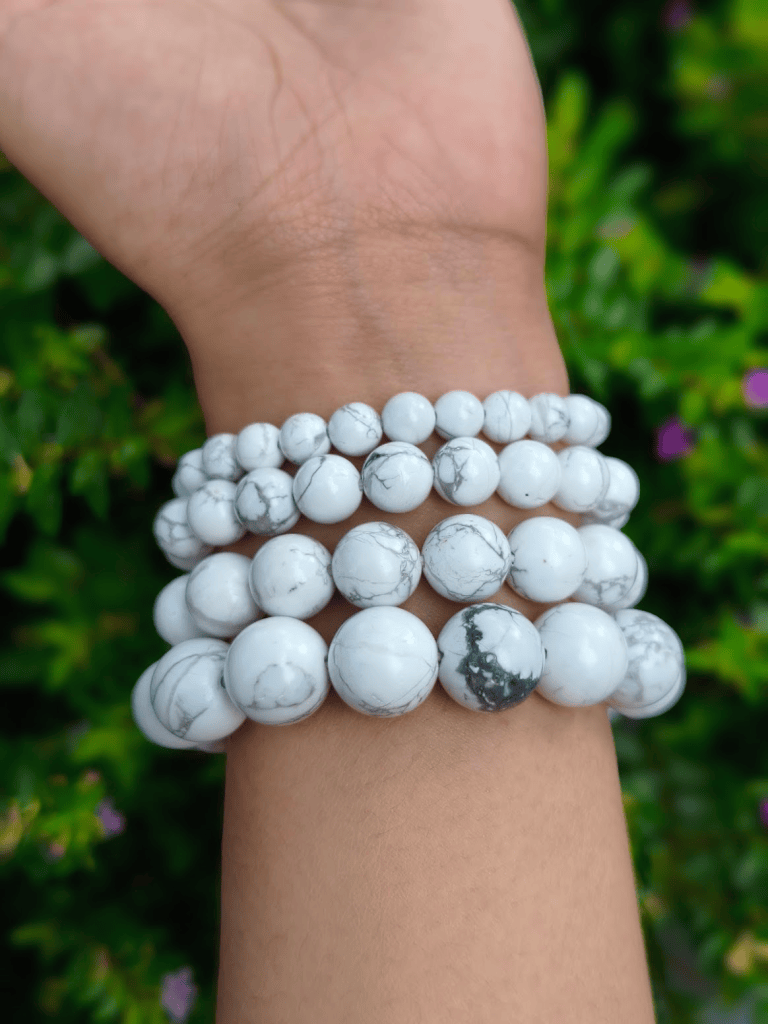
Borate Mineral (Calcium Borosilicate Hydroxide)
Howlite
Read the material story
Howlite is a white mineral first identified in Canada in the 19th century and later used in bead and ornamental carving. Its natural appearance—white with grey veining—has made it recognizable in contemporary jewelry and decorative objects. Because it was identified relatively late in geological classification, it does not appear prominently in early archaeological bead traditions. However, its porous structure allows it to be carved, polished, or dyed for modern adornment.
In TÁWID™: howlite represents adaptability and the evolving relationship between mineral discovery and artistic use.
Microcrystalline Quartz (Banded Chalcedony Trade Term)
Indian Agate
Read the material story
Indian agate refers to banded agate varieties historically exported from South Asia through Indian Ocean trade systems. These beads circulated widely into Southeast Asia and appear in Philippine archaeological contexts associated with maritime exchange networks. The material demonstrates early globalization long before European colonization. It reflects specialized bead production centers in Gujarat. Anthropologically, Indian agate is a clear marker of Indo-Pacific trade integration.
In TÁWID™: it represents historical linkage across water and time.
Crystalline Mineral (Pyroxene – Jade)
Jadeite
Read the material story
Jadeite became highly valued in imperial China, symbolizing moral authority and governance. It was sourced primarily from Myanmar and carved into ritual and elite objects. While jade circulated regionally in Southeast Asia, it is less dominant in Philippine archaeological assemblages compared to imported chalcedony beads. Jade historically functioned as a status and ritual material tied to hierarchy. Anthropologically, it demonstrates how mineral rarity shapes political symbolism.
In TÁWID™: jadeite represents dignified continuity and inherited responsibility.
Crystalline Mineral (Feldspar – Plagioclase)
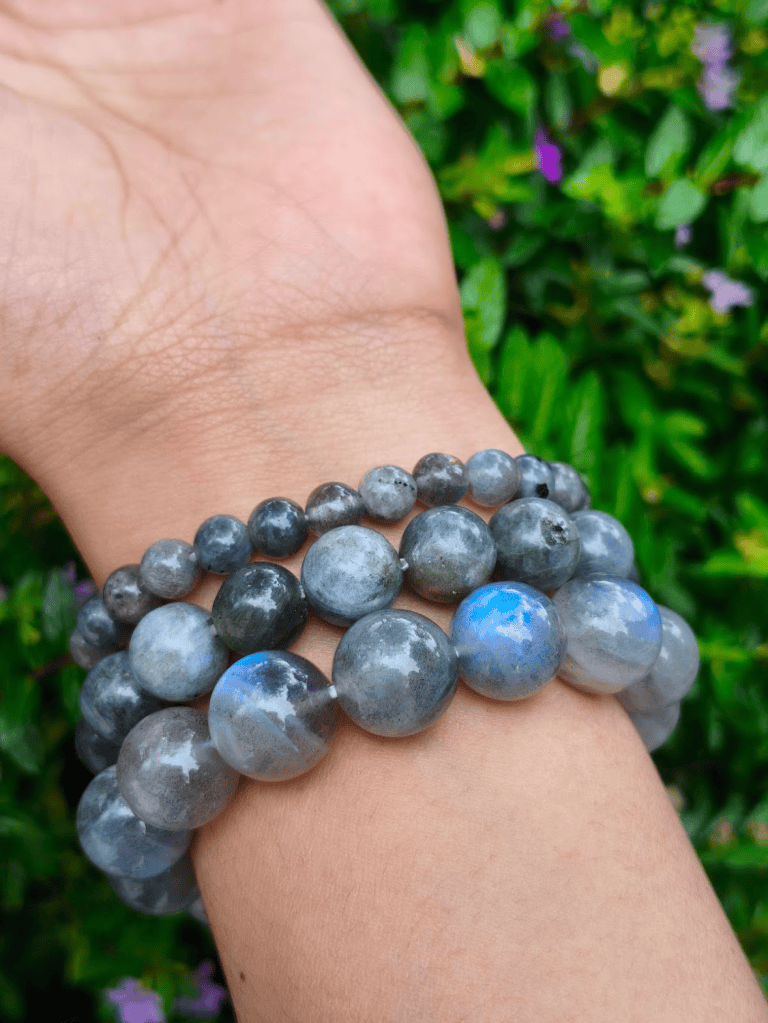
Labradorite
Read the material story
Labradorite was first identified in the 18th century in Canada and is primarily a modern ornamental stone. It does not have a documented role in ancient Indo-Pacific trade systems. Its iridescent labradorescence led to symbolic interpretations of transformation in contemporary gemstone culture. There is no archaeological evidence of labradorite in precolonial Philippine contexts. Anthropologically, it reflects postcolonial mineral circulation rather than ancient exchange.
In TÁWID™: it represents layered identity revealed through shifting light.
Metamorphic Rock (Primarily Lazurite with Calcite & Pyrite)
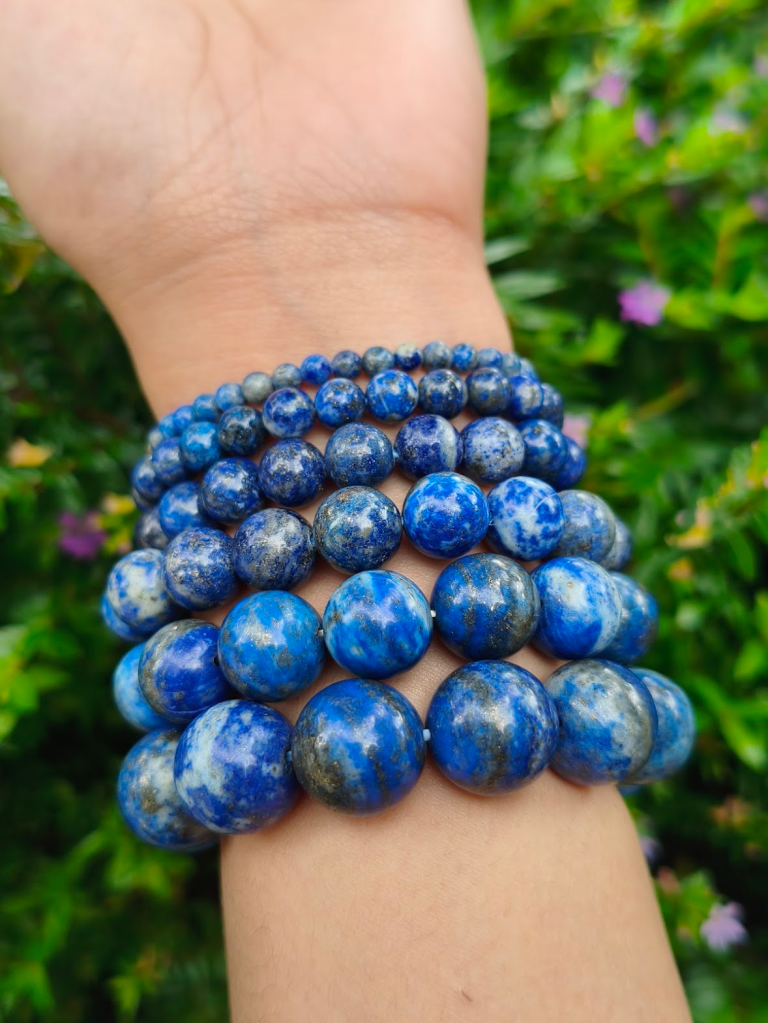
Lapis Lazuli
Read the material story
Lapis lazuli has been mined in Afghanistan for over 6,000 years and traded into Mesopotamia and Egypt. It symbolized prestige, divine favor, and authority in ancient civilizations. While it represents one of the earliest long-distance trade materials, it is not prominently documented in Philippine archaeological sites. Its trade networks were primarily continental rather than Indo-Pacific maritime. Anthropologically, lapis illustrates early transregional exchange linking Central Asia to the Mediterranean.
In TÁWID™: it signifies shared human connection through trade and knowledge.
Igneous Rock (Basalt – Extrusive)
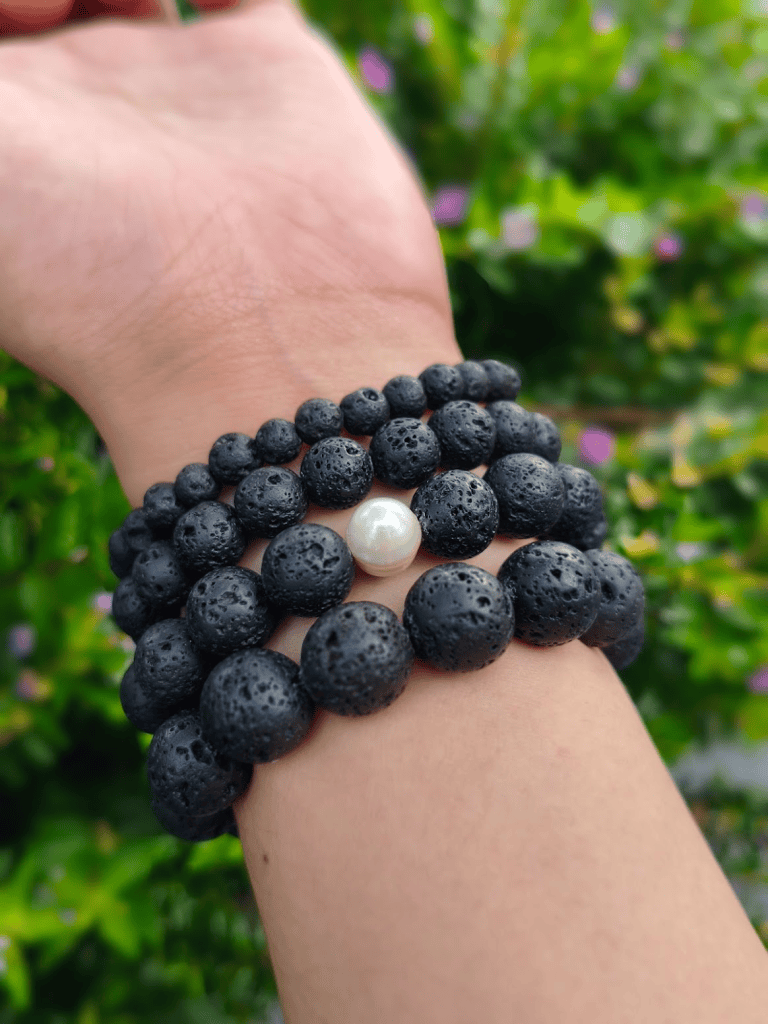
Lava Rock (Basalt)
Read the material story
Lava rock shares geological identity with basalt and reflects volcanic formation processes. In the Philippines, volcanic stone has long been part of domestic tool use due to geographic abundance. It is not a prestige trade material but a survival material shaped by environment. Anthropologically, it signals adaptation to tectonic landscapes. It reflects continuity between geology and daily life.
In TÁWID™: lava rock embodies resilience grounded in place.
Microcrystalline Quartz (Jasper Trade Name)
Madagascar Jasper
Read the material story
Madagascar jasper refers to jasper varieties sourced from Madagascar, a region that became globally significant in gemstone extraction during the 19th and 20th centuries. While jasper itself has ancient use across Egypt and Mesopotamia, the geographic branding “Madagascar” reflects modern mineral trade systems rather than early Indo-Pacific exchange. It does not appear in documented Philippine archaeological assemblages. Its presence in Southeast Asia today reflects contemporary global gemstone markets rather than precolonial maritime trade. Anthropologically, it illustrates how colonial and postcolonial extraction reshaped mineral circulation.
In TÁWID™: Madagascar jasper represents global movement integrated into local narrative without erasing origin.
Cryptocrystalline Mineral (Chalcedony – Quartz)
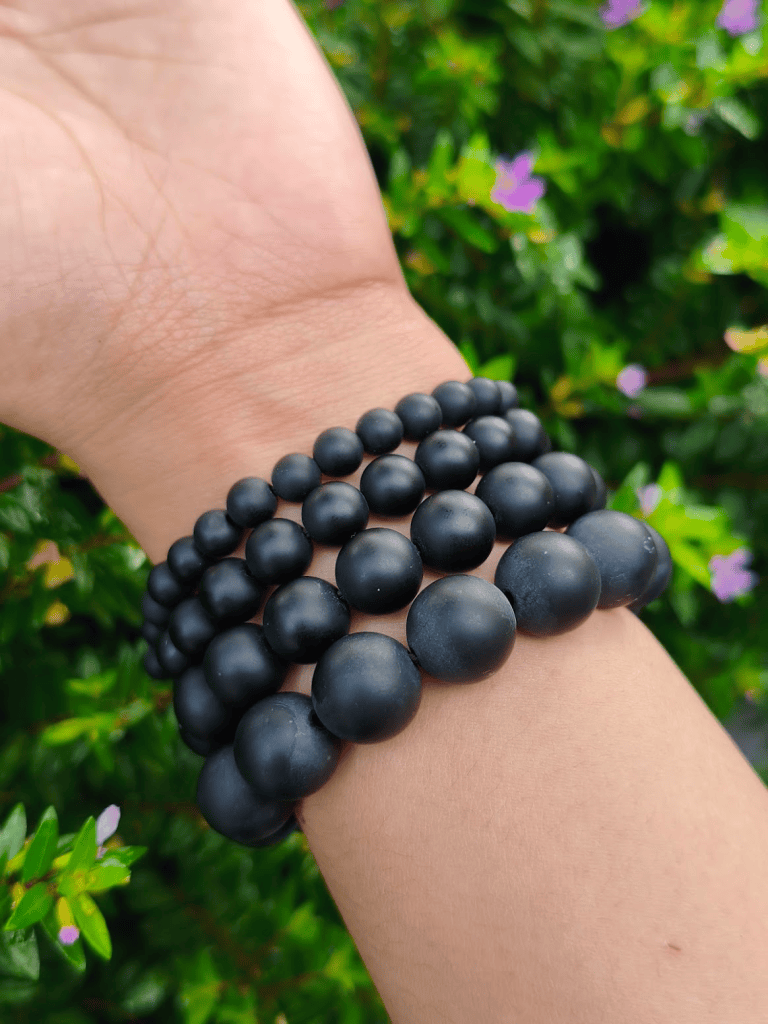
Matte Onyx
Read the material story
Onyx is a banded variety of chalcedony historically used across many regions for seals, beads, and engraved objects. In ancient Mediterranean and Near Eastern societies, onyx was valued for its durability and contrasting layers, which allowed artisans to carve detailed cameos and intaglios. The matte finish used in contemporary beadwork emphasizes the stone’s texture rather than reflective polish, highlighting the material’s natural depth. Archaeological evidence suggests black chalcedony varieties circulated widely through early trade networks linking South Asia, the Middle East, and Southeast Asia.
In TÁWID™: matte onyx represents grounded strength and quiet endurance within changing cultural landscapes.
Crystalline Mineral (Feldspar – Orthoclase / Albite)
Moonstone
Read the material story
Moonstone was used in Roman and South Asian jewelry, valued for its adularescent glow. It was symbolically associated with lunar cycles and agricultural rhythm in classical traditions. It circulated regionally in Asia but was not a dominant Indo-Pacific maritime trade bead entering Philippine archaeological contexts. Its significance derives more from optical beauty than scarcity. Anthropologically, moonstone reflects early fascination with natural light phenomena in mineral form.
In TÁWID™: it represents cyclical continuity and balance between motion and return.
Microcrystalline Quartz (Chalcedony with Mineral Inclusions)
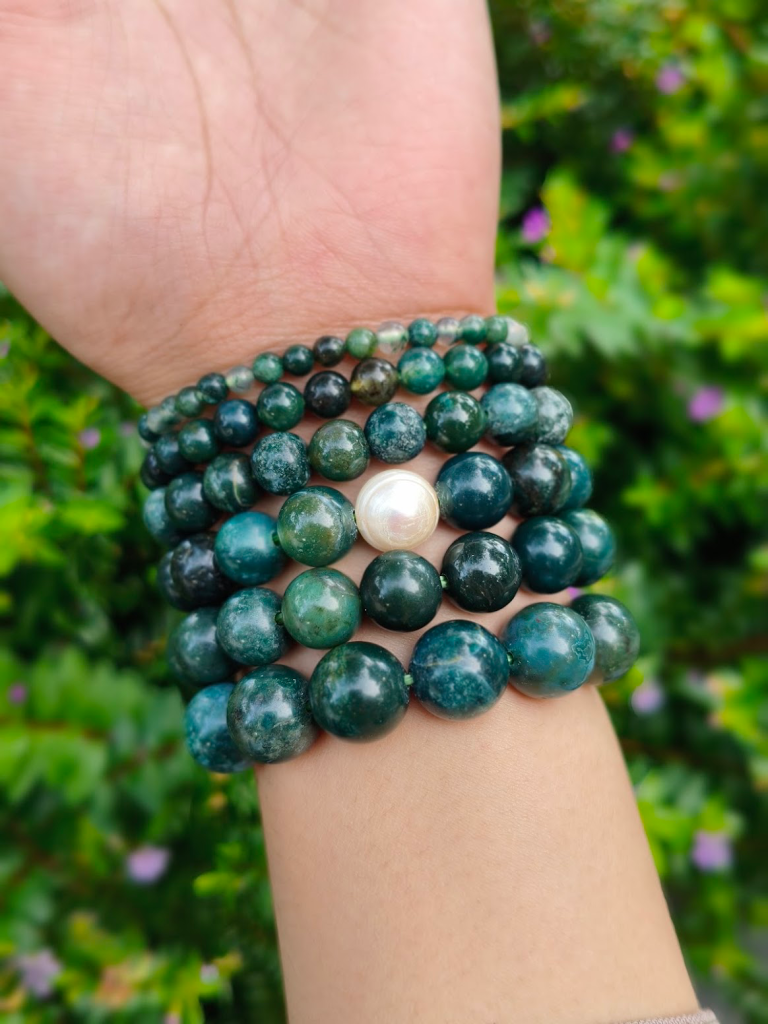
Moss Agate
Read the material story
Moss agate contains mineral inclusions that resemble vegetation, though it is not botanically organic. It has been used decoratively in carvings and beads but was not a major marker of Indo-Pacific trade networks. There is limited archaeological evidence of moss agate in Philippine precolonial contexts. Its appeal lies in visual resemblance to landscape and growth. Anthropologically, it demonstrates how natural patterns influence symbolic interpretation.
In TÁWID™: moss agate represents growth embedded within land memory.
Man-Made Glass (Artisanal)
Murano Glass (Chevron / Rosetta / Contemporary)
Read the material story
Murano glass beads are produced on the Venetian island of Murano, Italy, a center of glassmaking since the 13th century. Venetian artisans developed advanced glassworking techniques that allowed the production of colorful decorative beads, which became widely traded across Europe, Africa, and Asia. From the 16th century onward, European glass beads circulated globally through expanding colonial trade networks. In Southeast Asia, glass beads entered regional markets through Portuguese, Spanish, and Dutch trade routes, including the Manila–Acapulco galleon system that connected the Philippines with the Americas and Europe. While Murano glass beads do not appear in early precolonial Philippine archaeological assemblages, they illustrate the later globalization of decorative materials through maritime trade and colonial commerce.
In TÁWID™: Murano glass represents cultural exchange—how materials and craft traditions travel across oceans and become part of new stories of adornment.
Crystalline Mineral (Amphibole – Jade)
Nephrite Jade
Read the material story
Nephrite jade is a calcium-magnesium silicate mineral belonging to the amphibole group. It forms under high-pressure metamorphic conditions and is known for its toughness and smooth polish. Nephrite played a major role in the ancient exchange networks of East and Southeast Asia. Archaeological evidence shows that nephrite circulated through what scholars call the Maritime Jade Road (ca. 500 BCE – 1000 CE), a long-distance trade system linking Taiwan, the northern Philippines, and parts of Southeast Asia. Artifacts such as lingling-o ear pendants and jade bracelets discovered in Philippine archaeological sites demonstrate participation in this regional network of exchange and craftsmanship. Unlike many modern gemstones that entered Southeast Asia through later global trade, nephrite jade represents one of the earliest known prestige materials circulating within the region. Its presence in archaeological contexts highlights the technological skill and cultural connections of early island societies.
In TÁWID™: nephrite represents continuity across generations—heritage carried through craftsmanship, exchange, and time.
Volcanic Glass (Amorphous Natural Glass)
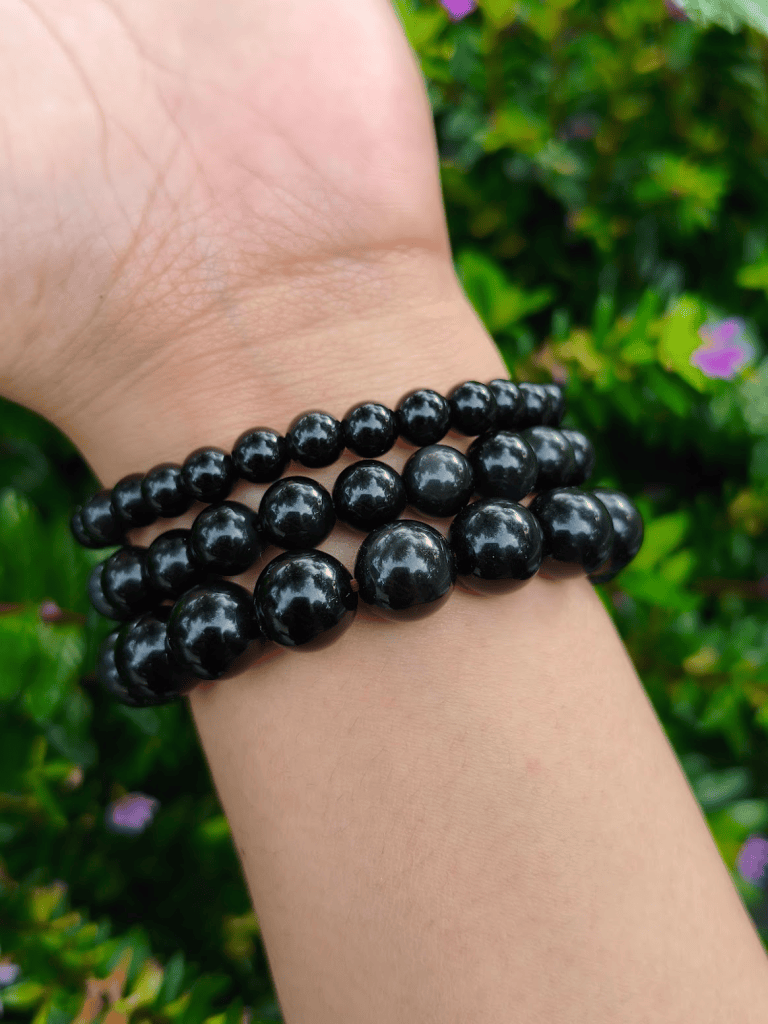
Obsidian (Black)
Read the material story
Obsidian has been used globally for blades and cutting tools due to its sharp fracture properties. In Southeast Asia, regional obsidian exchange networks have been documented, though the Philippines has limited natural deposits. Obsidian appears more often in tool contexts than ornamental bead trade. Its use reflects early technological sophistication and adaptation to volcanic landscapes. Anthropologically, obsidian artifacts allow geochemical sourcing that traces ancient movement.
In TÁWID™: obsidian represents clarity forged through fire and decisiveness grounded in survival.
Cryptocrystalline Mineral (Chalcedony – Quartz)
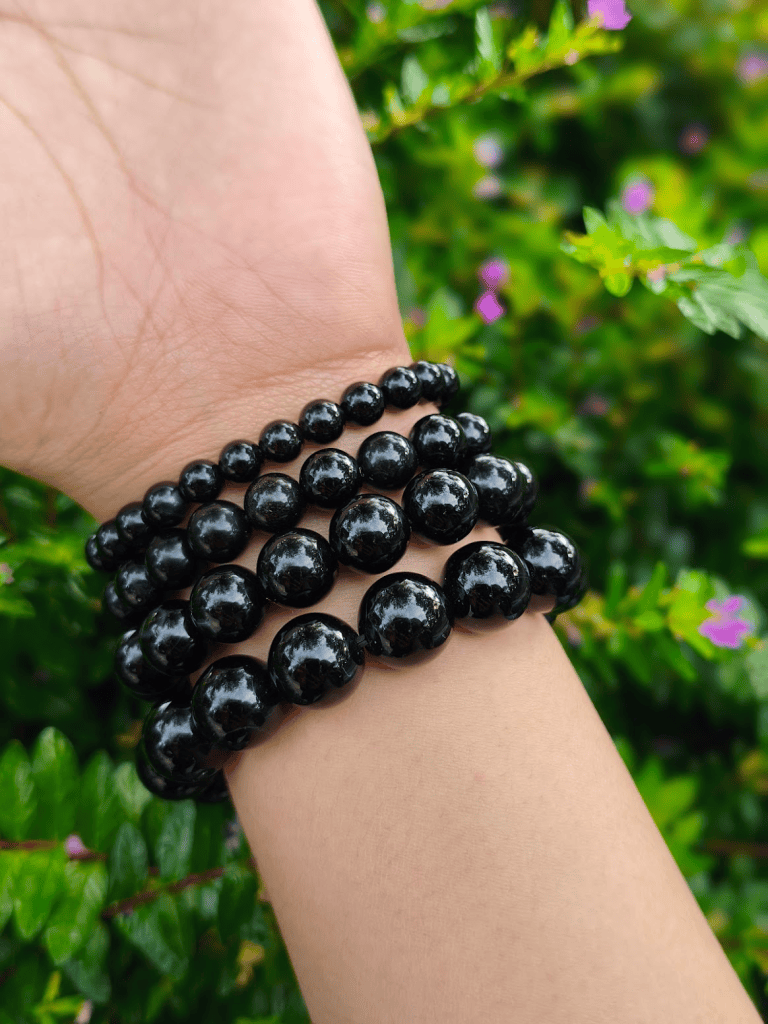
Onyx
Read the material story
Polished onyx has been used since antiquity in jewelry, decorative objects, and carved seals. The polishing process enhances the stone’s deep black surface, historically associated with formality and prestige in adornment traditions from the Mediterranean to South Asia. Because chalcedony varieties traveled widely through trade networks, onyx beads became part of exchange systems that connected multiple regions. Unlike matte finishes, polished onyx highlights reflectivity and uniform color, emphasizing refinement and craftsmanship.
In TÁWID™: polished onyx represents clarity, composure, and the balance between natural material and human shaping.
Man-Made Glass (Opal Imitation)
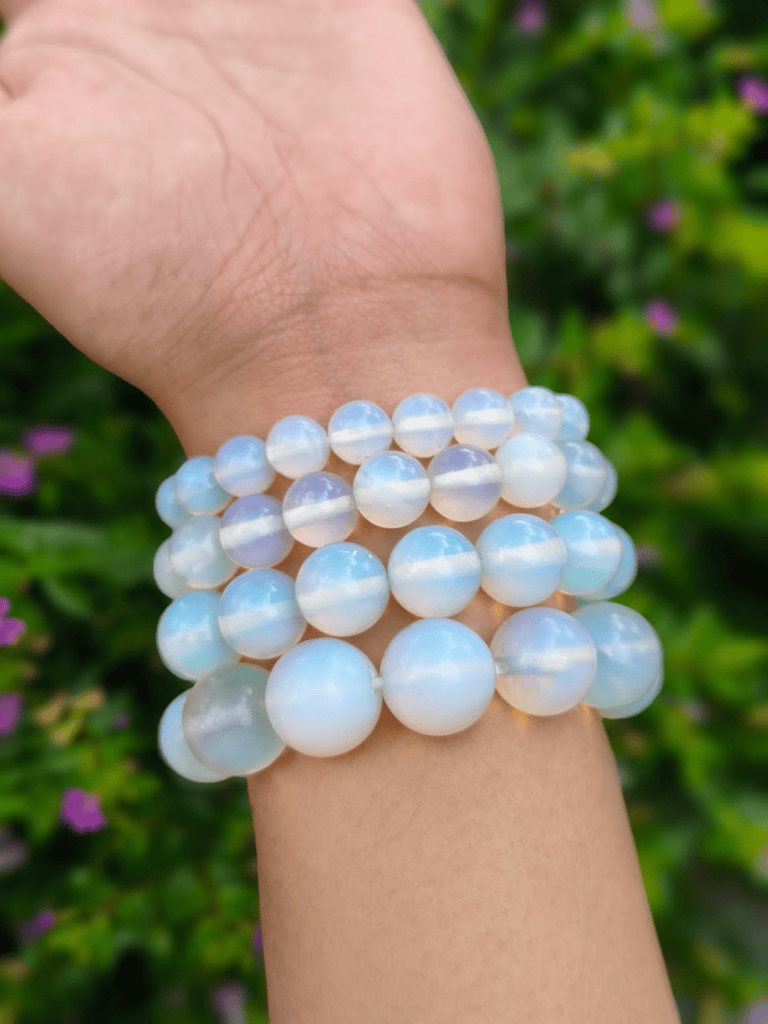
Opalite
Read the material story
Opalite is a man-made glass material produced to imitate the appearance of natural opal. Unlike natural opal, which forms from hydrated silica deposits over geological timescales, opalite is manufactured through controlled glass production processes. Because it is a modern synthetic material, opalite has no presence in archaeological contexts or historical trade systems. Its use reflects contemporary decorative practices rather than ancient mineral heritage.
In TÁWID™: opalite represents transparency about origin and material identity. It reminds us that modern craftsmanship can coexist with historical awareness when materials are presented honestly and responsibly.
Organic / Biogenic Calcium Carbonate (Aragonite)
Pearl (Philippine Pearls Included)
Read the material story
Pearls have been prized since antiquity in India, China, Persia, and Rome, symbolizing status and refinement due to their rarity and marine origin. The Philippines has long been a historically significant source of natural pearls, particularly in Mindanao and Palawan, contributing to precolonial and colonial maritime wealth. Archaeological evidence across island Southeast Asia confirms the use of pearl and shell materials in adornment. Pearls reflect marine ecology integrated into material culture. Anthropologically, they signify the economic and symbolic importance of sea-based societies.
In TÁWID™: pearl represents ocean lineage and beauty formed through time and patience.
Crystalline Mineral (Olivine)
Peridot
Read the material story
Peridot was mined in ancient Egypt, particularly on Zabargad Island, and circulated within Mediterranean trade systems. Its bright green color led to associations with vitality and renewal. It was not a dominant Indo-Pacific maritime trade stone entering Philippine archaeological assemblages. Peridot forms deep within the Earth’s mantle and reaches the surface through volcanic activity, linking it to tectonic processes. Anthropologically, it demonstrates how geological origin influences symbolic interpretation.
In TÁWID™: peridot represents emergence through pressure and resilience born from depth.
Metamorphic Rock (Often Marble or Dolomite-Based; Trade Name)
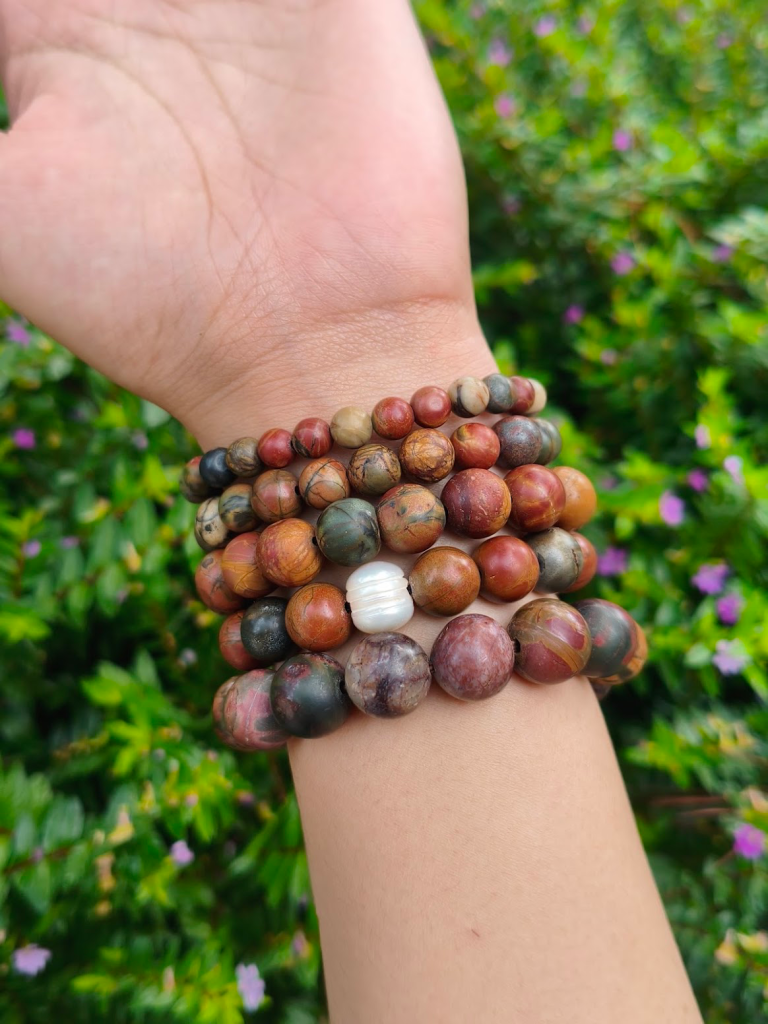
Picasso Jasper
Read the material story
Picasso jasper is a commercial trade name applied to patterned metamorphic stone resembling abstract brushstrokes. Unlike true chalcedony jasper, it may be limestone or dolomite-based. It does not appear in ancient Indo-Pacific trade networks or Philippine archaeological contexts. Its popularity reflects modern aesthetic branding rather than historical continuity. Anthropologically, it illustrates how naming shapes perceived identity of materials.
In TÁWID™: Picasso jasper represents narrative shaped through fracture and reassembly.
Microcrystalline Quartz (Jasper)
Pink Jasper
Read the material story
Pink jasper belongs to the broader chalcedony family historically used in seals and amulets. Jasper circulated regionally in Asia but was less dominant in Indo-Pacific trade compared to carnelian and agate. There is limited specific archaeological evidence for pink jasper in Philippine contexts. Its color derives from iron inclusions, reflecting geological variation. Anthropologically, it demonstrates aesthetic appreciation of earth-toned minerals.
In TÁWID™: pink jasper represents gentle strength rooted in land memory.
Crystalline Mineral (Boron Silicate – Elbaite)
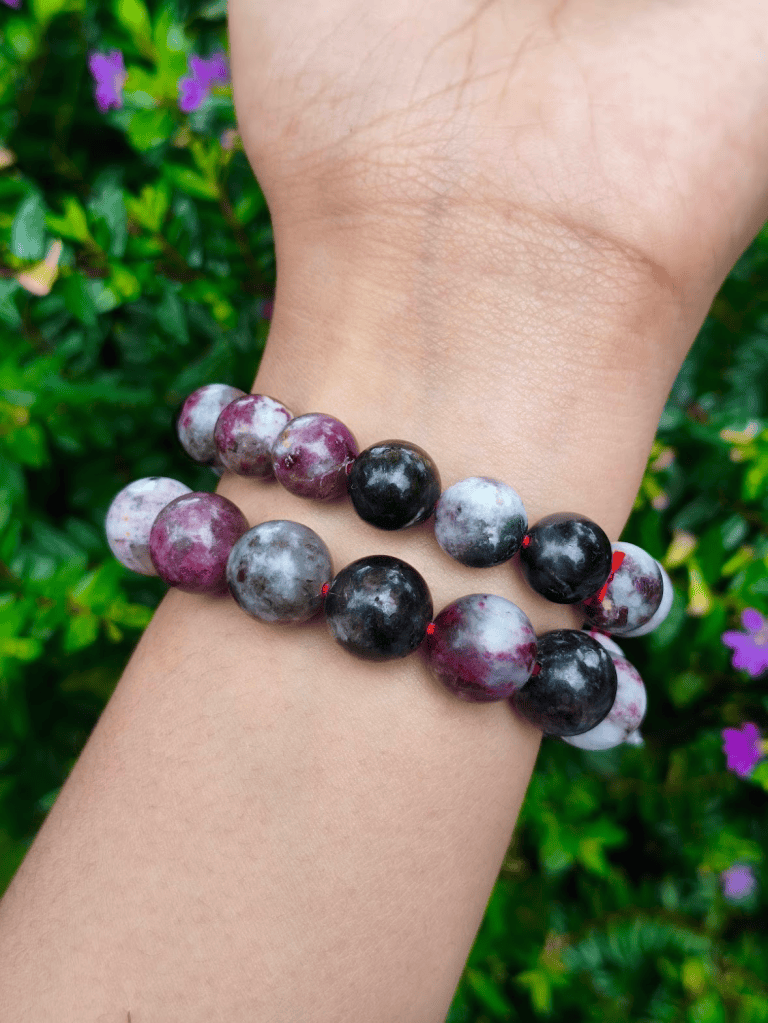
Pink Tourmaline
Read the material story
Tourmaline has been traded in Sri Lanka, Africa, and Asia for centuries, with the name deriving from the Sinhalese word turmali. Pink varieties became especially popular during colonial-era gemstone extraction. It is not prominently documented in Philippine archaeological assemblages. Tourmaline’s electrical properties were noted in early European mineralogical studies. Anthropologically, it reflects global mineral diversity shaped by colonial trade expansion.
In TÁWID™: pink tourmaline represents coexistence and multiplicity within a single lineage.
Crystalline Mineral (Iron Sulfide)
Pyrite
Read the material story
Pyrite has been used historically for fire-making due to its spark-producing properties when struck against metal or stone. It was also fashioned into mirrors in Mesoamerican contexts and valued for its metallic luster. Pyrite does not appear prominently in Indo-Pacific bead trade or Philippine archaeological ornament assemblages. Its resemblance to gold influenced symbolic interpretations of wealth and discernment. Anthropologically, it reflects early experimentation with mineral properties.
In TÁWID™: pyrite represents discernment—recognizing substance beyond appearance.
Microcrystalline Quartz (Chalcedony)
Red Agate
Read the material story
Red agate circulated within Indo-Pacific maritime trade systems and overlaps archaeologically with carnelian varieties. Philippine archaeological sites containing imported chalcedony beads may include red agate among assemblages. Its coloration results from iron oxide content or treatment. It reflects continuity of bead-making traditions in South Asia. Anthropologically, it signifies trade networks connecting coastal communities.
In TÁWID™: red agate represents vitality carried through movement.
Crystalline Mineral (Manganese Carbonate)
Rhodochrosite
Read the material story
Rhodochrosite has decorative history in South America and Europe, often used for carvings and ornamental objects. Its softness limits durability compared to quartz, making it less common in ancient bead trade systems. It is not documented in Philippine archaeological contexts. Its banded pink coloration inspired symbolic associations with emotional depth in modern mineral lore. Anthropologically, it reflects ornamental appreciation rather than trade dominance.
In TÁWID™: rhodochrosite represents memory held with tenderness and resilience.
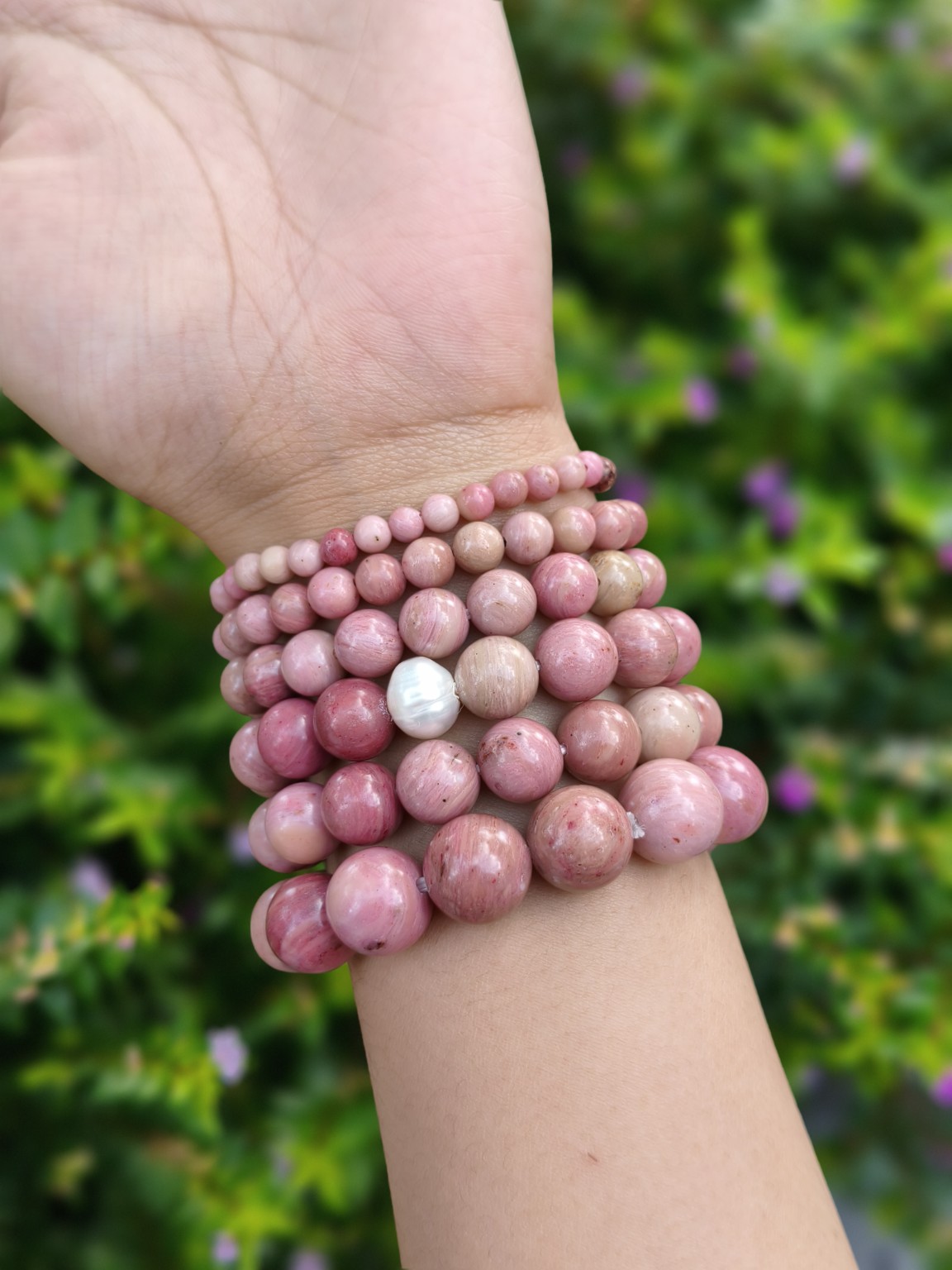
Available now
Round-bead bracelets
Sizes: 4 mm · 6 mm · 8 mm · 10 mm · 12 mm · 14 mm · 16 mm
4 mm: ₱350 · 6 mm: ₱400 · 8 mm: ₱450
10 mm: ₱500 · 12 mm: ₱550 · 14/16 mm: ₱600
10 mm with pearl: ₱800
Chipstone: Not available.
Final availability, bead variation, and bracelet fit are confirmed through Message to Order.
Message to order RhodochrositeManganese Silicate Mineral
Rhodonite
Read the material story
Rhodonite is a manganese silicate mineral recognized for its pink to rose coloration often intersected by black manganese oxide veins. Historically, the stone gained prominence in decorative arts during the 18th and 19th centuries, particularly in Russia where large deposits in the Ural Mountains were developed and used for ornamental carvings, architectural panels, and jewelry. Its distinctive contrast between pink crystal and dark veining made it visually recognizable in lapidary traditions and imperial decorative arts. Although quartz and chalcedony varieties appear more frequently in early Indo-Pacific bead trade networks, rhodonite illustrates how mineral discoveries in different regions introduced new materials into ornamental traditions over time. Anthropologically, it reflects the relationship between geological discovery and the expansion of decorative stone use in global material culture.
In TÁWID™: rhodonite represents emotional resilience and the enduring relationship between natural mineral formation and cultural interpretation.
Crystalline Mineral (Quartz)
Rose Quartz
Read the material story
Rose quartz was used in Roman seals and small amulets, symbolizing reconciliation and social harmony. Quartz varieties are geologically widespread, including in parts of Southeast Asia. Rose quartz is not prominently documented in Philippine precolonial bead assemblages. Its pale coloration derives from trace mineral inclusions. Anthropologically, it demonstrates universal accessibility of quartz materials.
In TÁWID™: rose quartz represents communal care grounded in durability.
Organic / Biogenic Calcium Carbonate
Seashell
Read the material story
Shell ornaments are abundant in Philippine archaeological sites and reflect coastal resource adaptation. Precolonial Austronesian communities used shell for beads, pendants, and ritual objects. Shell materials signify integration of marine ecology into daily life. Unlike imported bead stones, shells represent indigenous material continuity. Anthropologically, they demonstrate maritime livelihood and localized craft production.
In TÁWID™: seashell represents origin, belonging, and ecological inheritance.
Metamorphic Rock Group (Hydrated Magnesium Silicate)
Serpentine
Read the material story
Serpentine has been carved into ornaments in China and Mesoamerica and sometimes substituted for jade due to similar appearance. It was not a dominant Indo-Pacific maritime bead export into Philippine contexts. Its green coloration often inspired associations with vitality and land. Anthropologically, serpentine reflects material substitution in craft traditions when jade was scarce. It demonstrates adaptability in material culture.
In TÁWID™: serpentine represents flexible strength within continuity.
Quartz Variety (Aventurine)
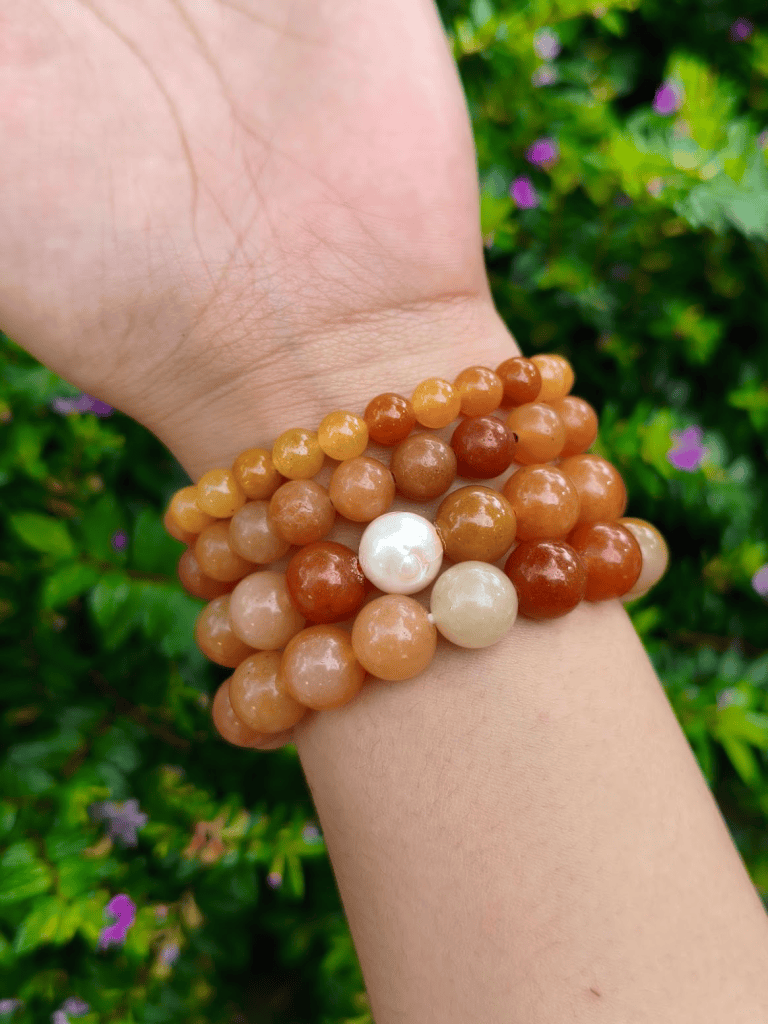
Shallow Pink Aventurine
Read the material story
Aventurine is a form of quartz characterized by inclusions that produce a subtle shimmering effect known as aventurescence. Pink varieties occur when mineral inclusions alter the coloration of the quartz. Historically, quartz varieties have been widely used for beads and ornamentation due to their relative abundance and durability. Aventurine itself is more commonly associated with later decorative stone use rather than early prestige trade goods.
In TÁWID™: pink aventurine represents gentle resilience and the quiet beauty found in naturally varied minerals.
Volcanic Glass (Amorphous Natural Glass)
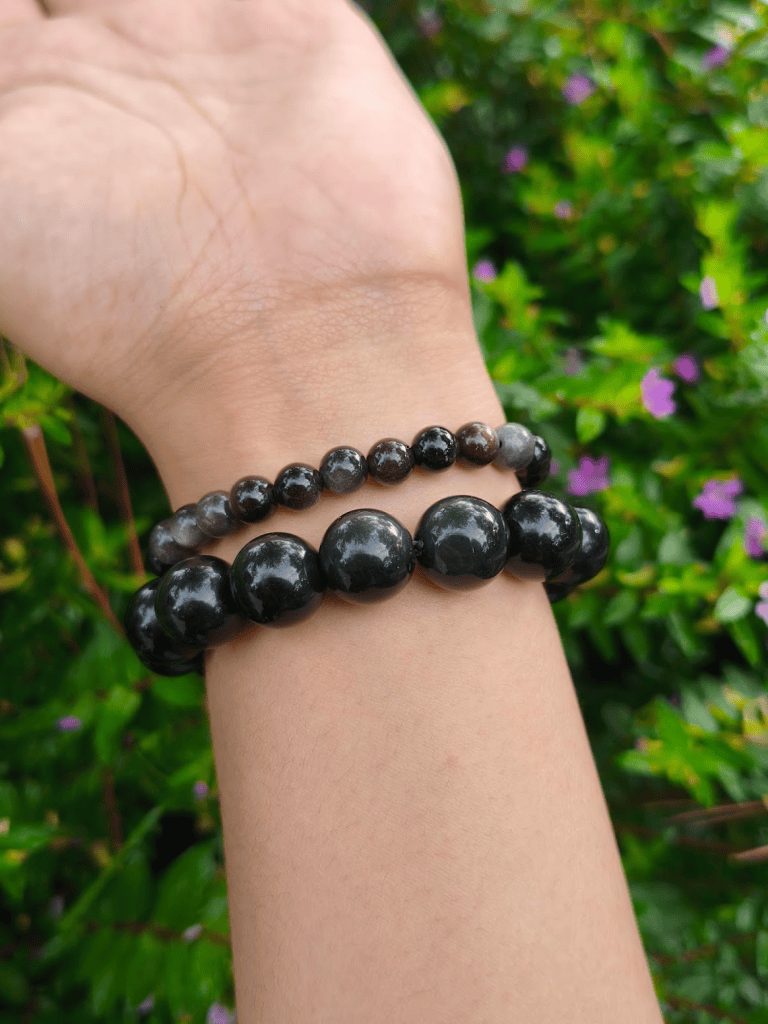
Silver Sheen Obsidian
Read the material story
Silver sheen obsidian forms when gas inclusions align during cooling, creating reflective striations. Obsidian’s global use in tool production reflects its cutting efficiency. Southeast Asian exchange networks included regional obsidian movement, though Philippine deposits are limited. Its sheen variant is more ornamental than utilitarian. Anthropologically, it shows how technological materials transition into decorative use.
In TÁWID™: silver sheen obsidian represents reflective strength emerging from volcanic origin.
Crystalline Mineral (Quartz)
Smoky Quartz
Read the material story
Smoky quartz gains its coloration from natural radiation interacting with aluminum impurities. It was used in European jewelry traditions and appears in regional Asian contexts. It is not strongly documented in Philippine precolonial trade assemblages. Its darker tone inspired symbolic associations with grounding. Anthropologically, it reflects geological variation within common quartz.
In TÁWID™: smoky quartz represents depth without obscurity—strength rooted in quiet presence.
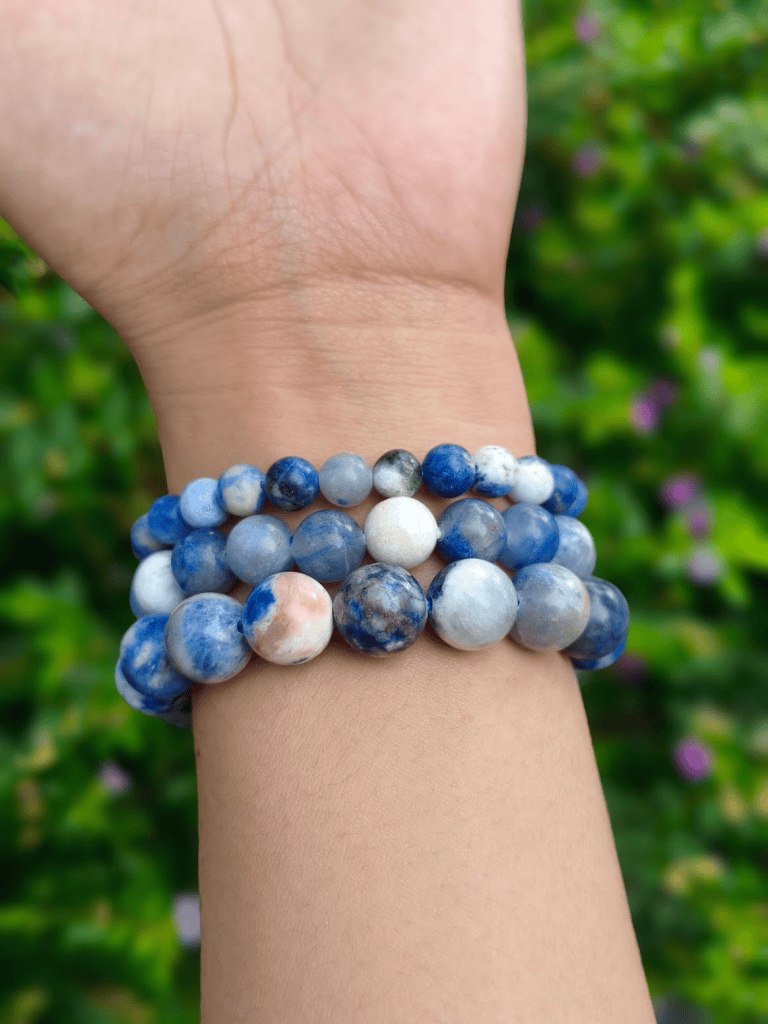
Crystalline Mineral (Tectosilicate Feldspathoid)
Sodalite
Read the material story
Sodalite became prominent in 19th-century decorative arts, especially after discoveries in Canada. It lacks a significant role in ancient Indo-Pacific maritime trade systems. There is no strong archaeological evidence of sodalite in precolonial Philippine contexts. Its deep blue coloration often led to comparison with lapis lazuli. Anthropologically, it reflects modern ornamental mineral circulation.
In TÁWID™: sodalite represents structured thought and clarity of expression.
Crystalline Quartz (Rare Natural) / Man-Made Glass (Common Trade)
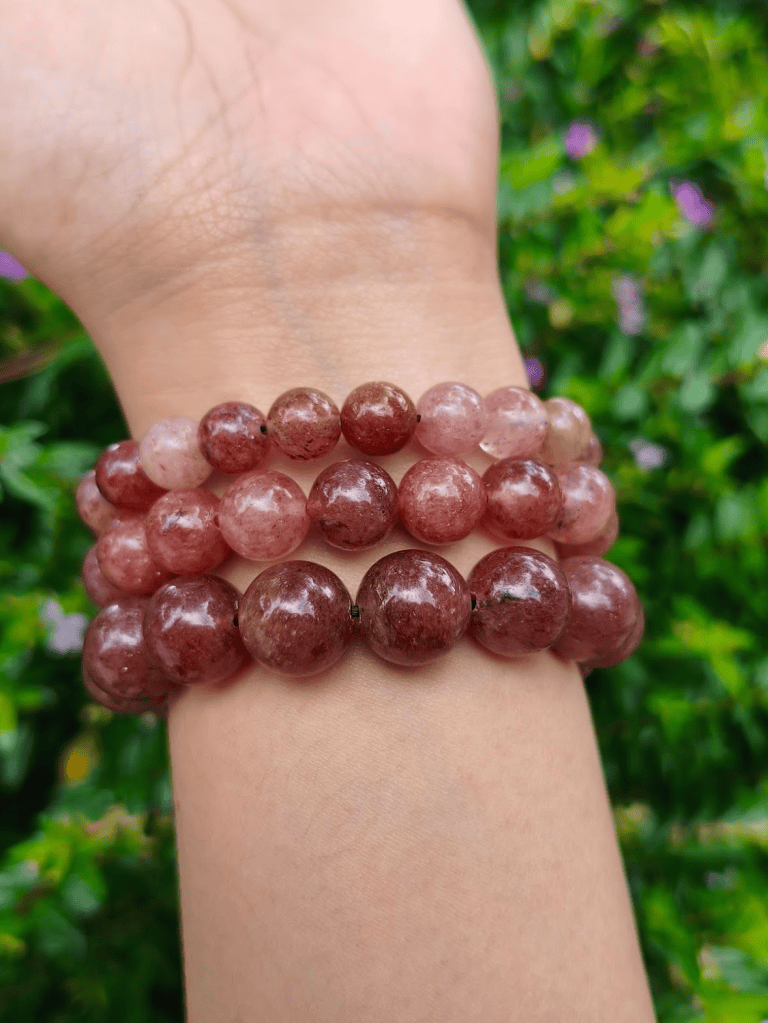
Strawberry Quartz (Natural or Glass Version)
Read the material story
Strawberry quartz refers to quartz containing red mineral inclusions that produce a speckled or “strawberry-like” appearance. Natural specimens exist but are relatively uncommon. Many stones sold under this name are actually glass imitations or treated quartz designed to enhance color and clarity. Because of this variation, strawberry quartz is best understood as part of modern gemstone commerce rather than ancient bead traditions. It illustrates how contemporary markets adapt natural mineral aesthetics through technological processes.
In TÁWID™: strawberry quartz represents the evolving relationship between natural materials and modern craft—acknowledging both geological formation and contemporary production.
Microcrystalline Quartz (Pseudomorph After Crocidolite)
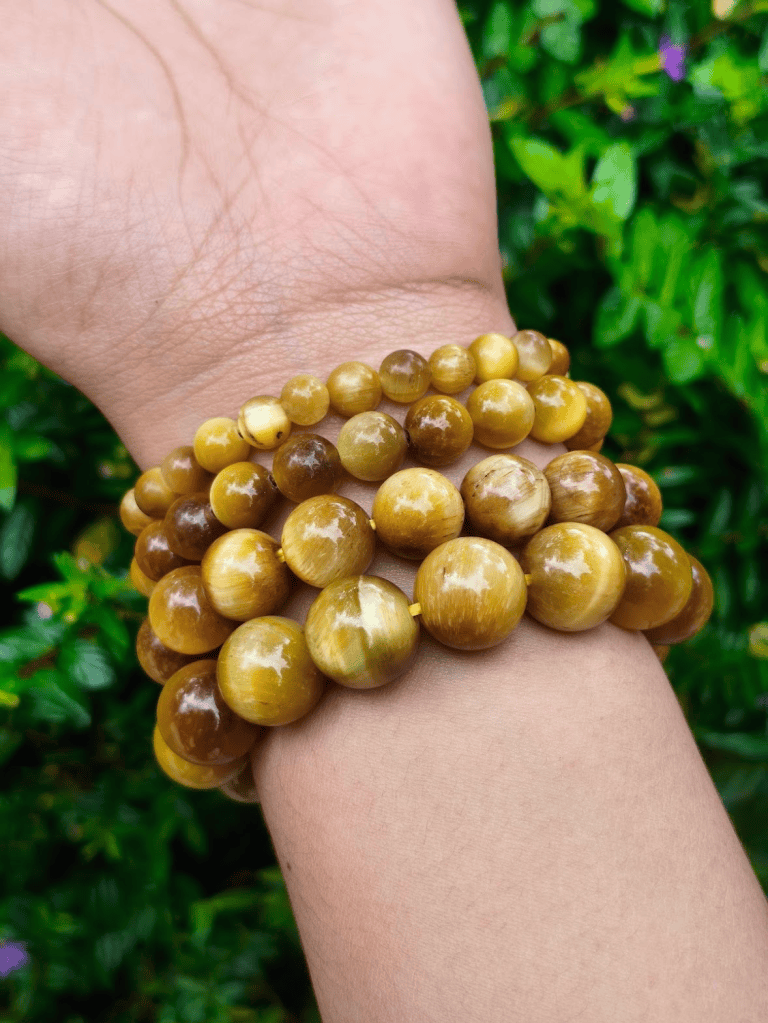
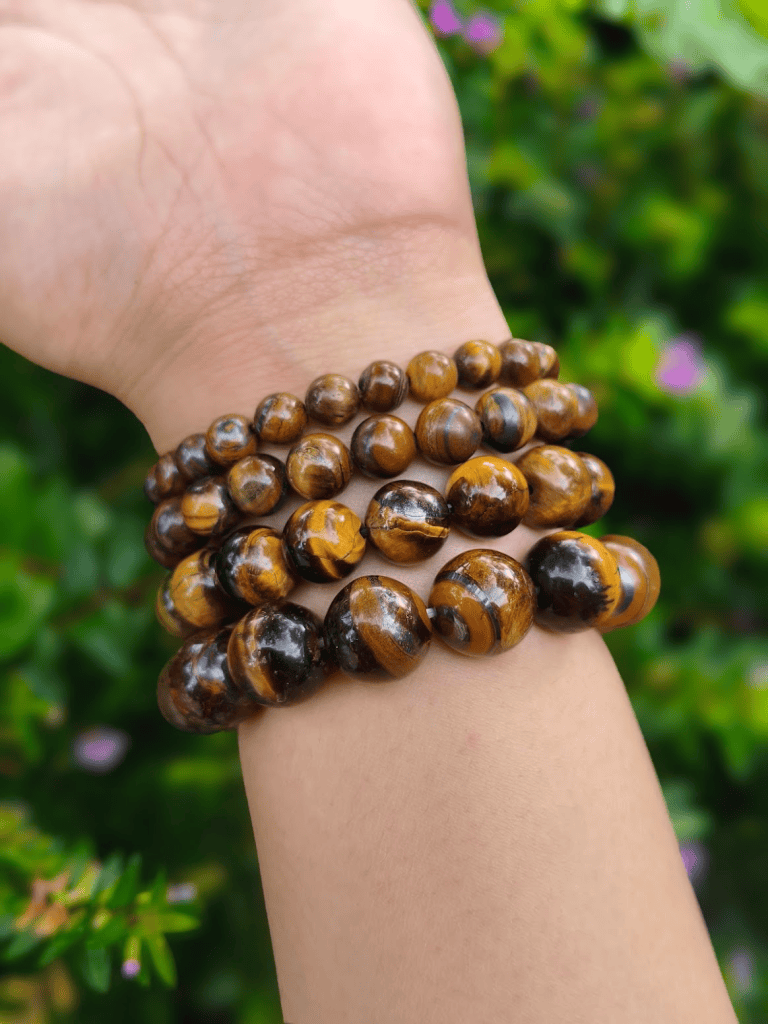
Tiger’s Eye
Read the material story
Tiger’s eye forms through the replacement of fibrous crocidolite with quartz, preserving its chatoyant structure. It was used in Roman amulets and later circulated widely during colonial mineral trade expansion from southern Africa. It is not strongly documented in Philippine archaeological assemblages. Its optical banding inspired symbolic associations with vigilance and protection in modern interpretations. Anthropologically, it reflects how distinctive mineral structures shape cultural meaning.
In TÁWID™: tiger’s eye represents alert resilience grounded in awareness rather than superstition.
Crystalline Mineral (Hydrated Copper Aluminum Phosphate; Often Stabilized)
Turquoise
Read the material story
Turquoise was highly valued in ancient Egypt, Persia, and Mesoamerica, often symbolizing protection and safe journey. Its scarcity contributed to its prestige across cultures. It does not appear prominently in Philippine archaeological records, as Indo-Pacific trade favored chalcedony varieties. Stabilization treatments are common in modern markets to strengthen porous material. Anthropologically, turquoise demonstrates how rarity elevates social status in material culture.
In TÁWID™: Turquoise represents guarded passage.
Microcrystalline Quartz
White Chalcedony
Read the material story
White chalcedony was used in seals, beads, and carved ornaments across Mediterranean and Asian contexts. It circulated into Southeast Asia through established maritime exchange networks. Philippine burial assemblages confirm imported chalcedony beads consistent with long-distance trade. Its fine texture allowed detailed craftsmanship. Anthropologically, it reflects early globalization through bead circulation.
In TÁWID™: white chalcedony represents understated resilience within movement.
Igneous Rock (Syenite Containing Fluorescent Sodalite)
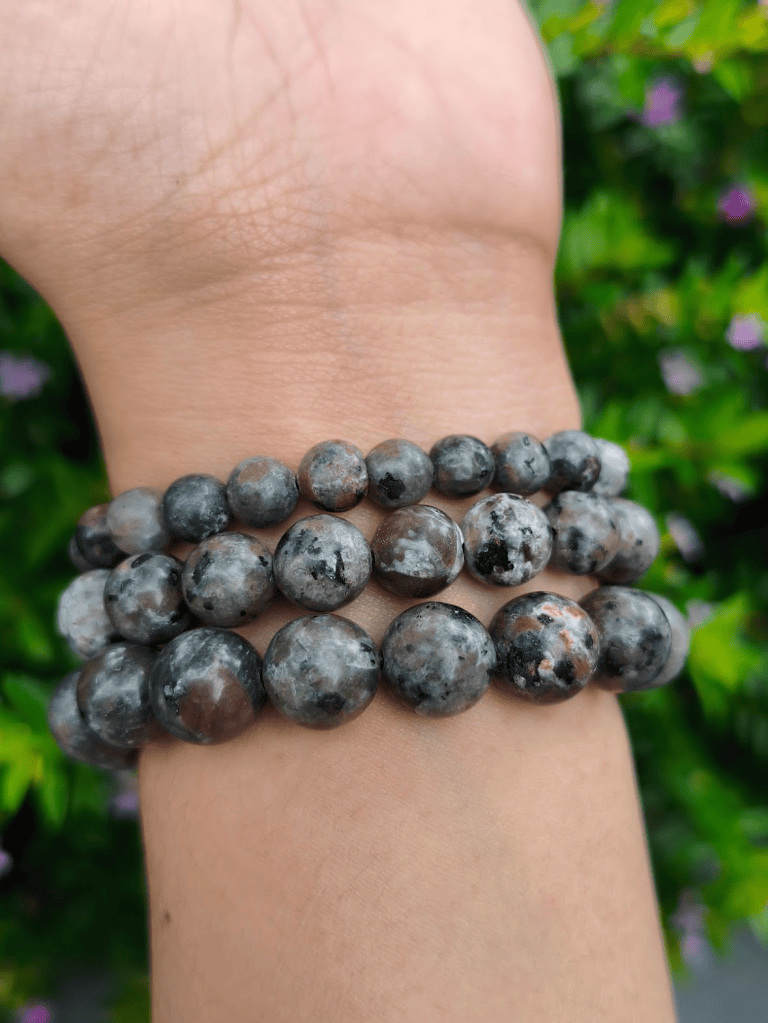
Yooperlite (Sodalite-Bearing Syenite)
Read the material story
Yooperlite is a modern trade name for fluorescent sodalite-bearing syenite discovered in North America. It has no ancient trade record and no presence in Philippine archaeological contexts. Its popularity derives from ultraviolet fluorescence rather than historical use. It represents contemporary mineral discovery and branding. Anthropologically, it illustrates how scientific identification shapes modern fascination with stone.
In TÁWID™: yooperlite represents wonder grounded in geological knowledge.
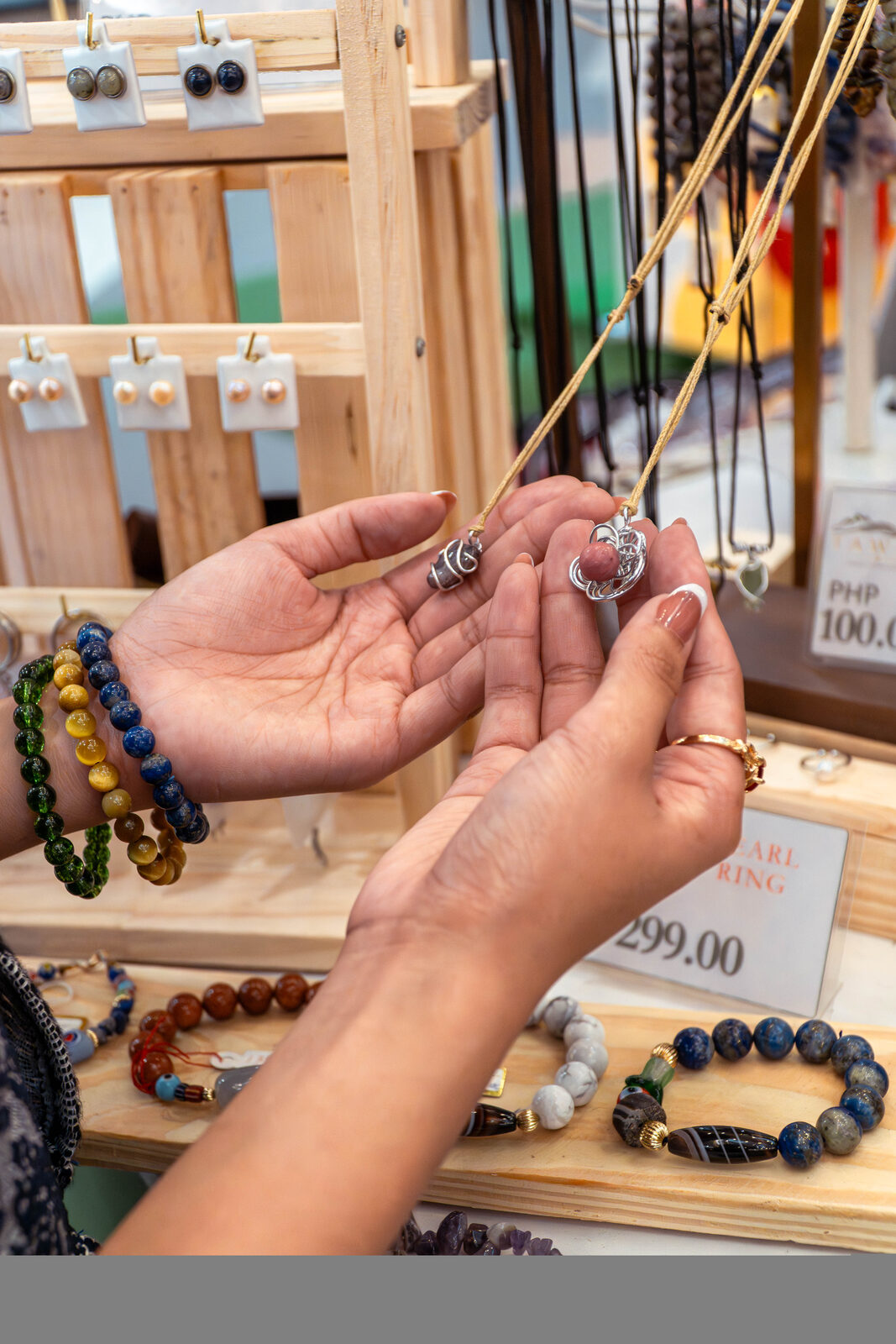
BEFORE YOU ORDER
Ask for the piece details.
- Material and visible natural variation
- Dimensions, fit, and available sizing
- Care guidance and repair eligibility
- Provenance or cultural context, where verified
- Current price and collection or delivery options
TÁWID™ does not make medical or metaphysical claims. Any symbolism described by the brand is clearly framed as “In TÁWID…” rather than presented as universal fact.
Inabel & Habi · Available to order
Threads chosen.
Stories carried.
Meet TÁWID™’s Inabel & Habi garments. Every garment pictured here is for sale. Send a screenshot or its TEXTILE number through Message to Order to confirm the current price, fit, and delivery or collection.
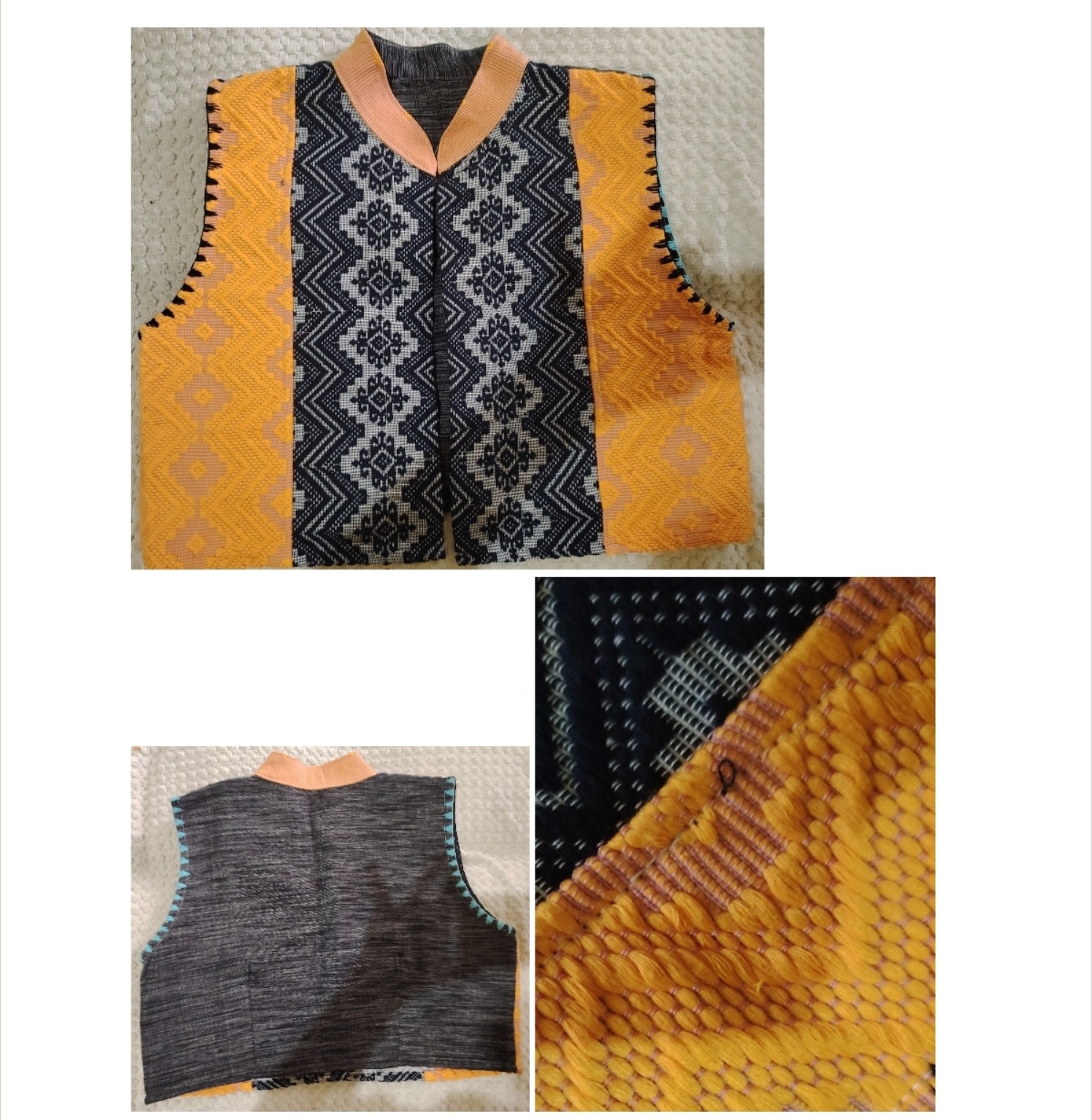
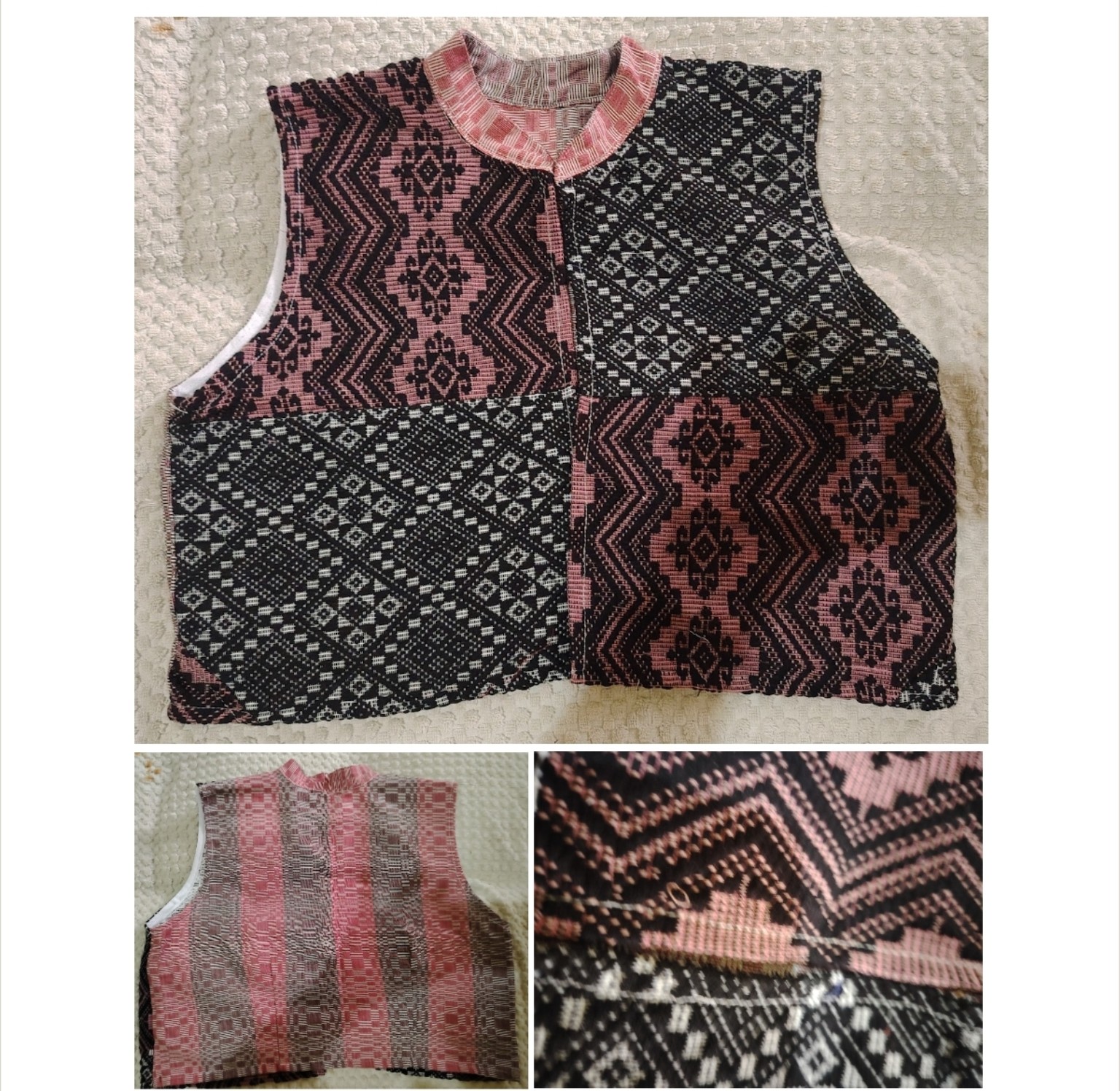
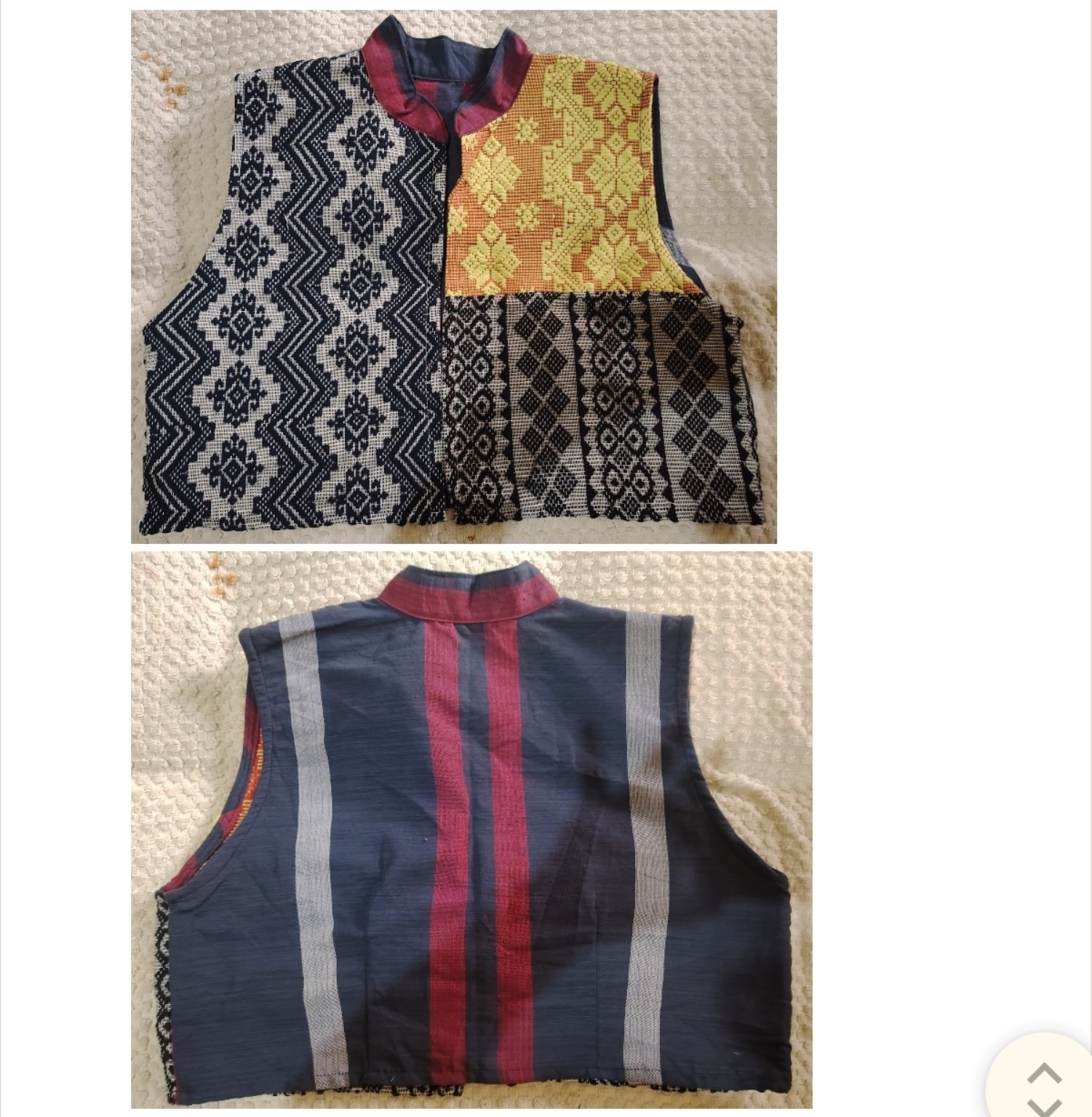
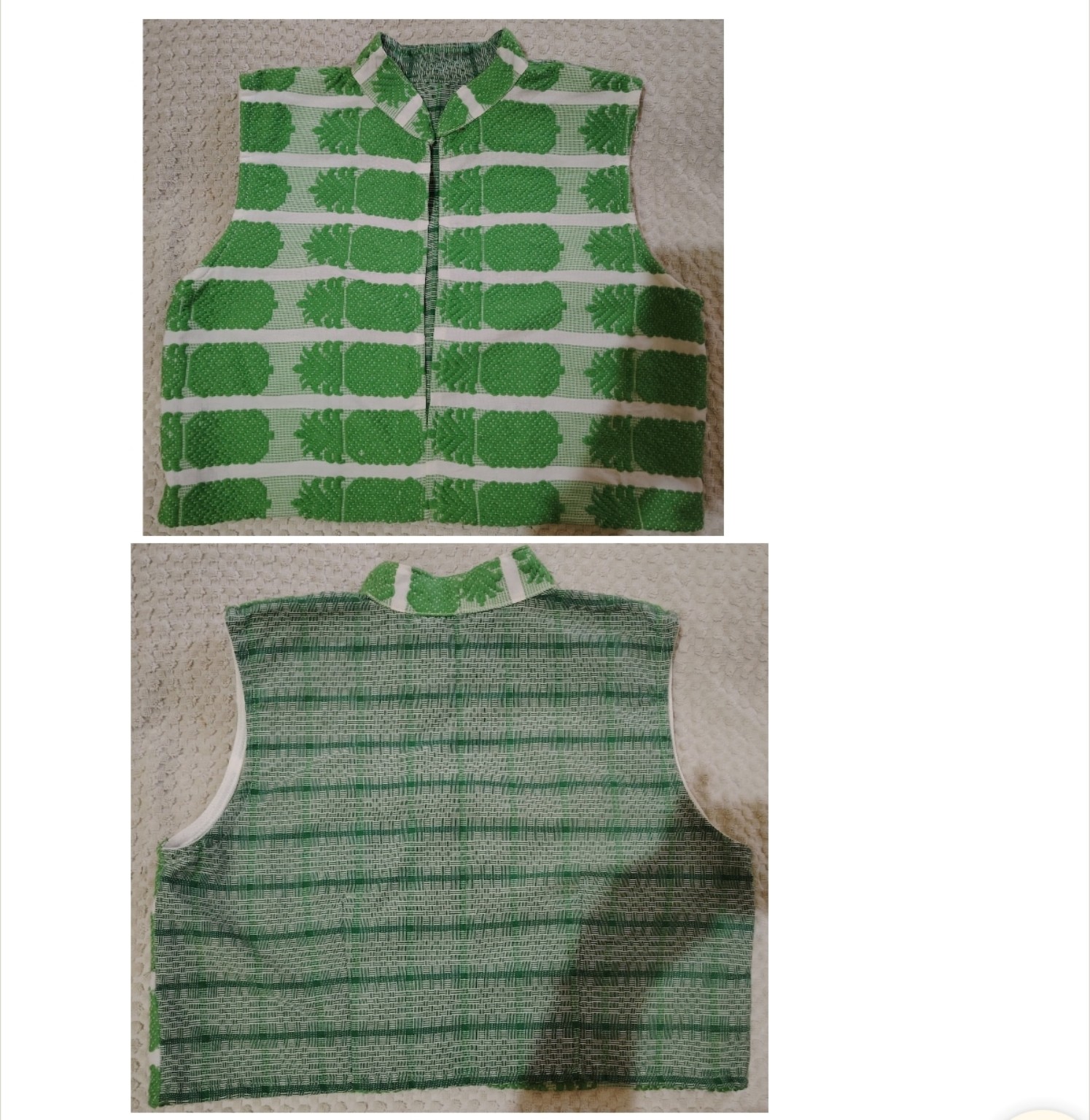
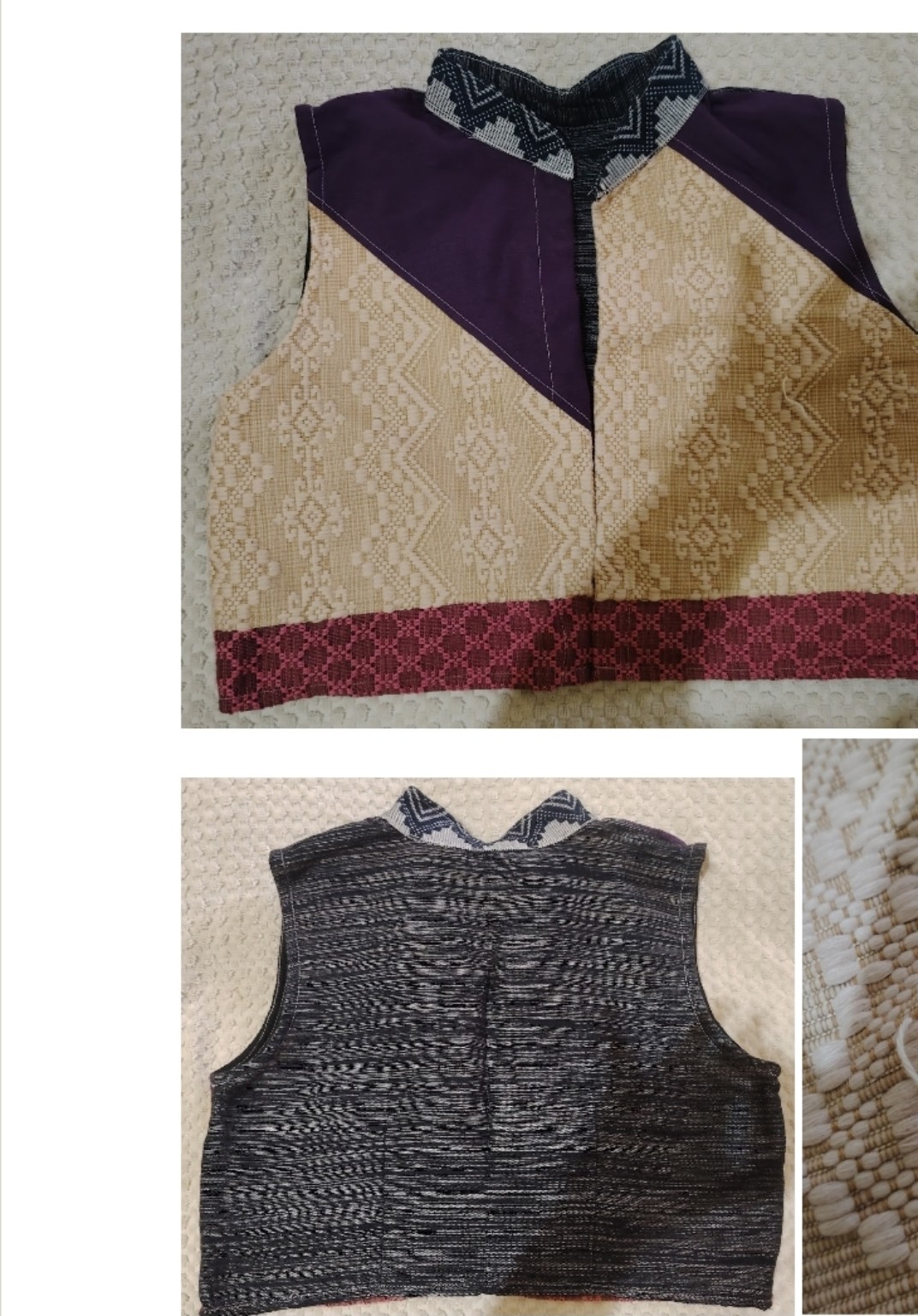
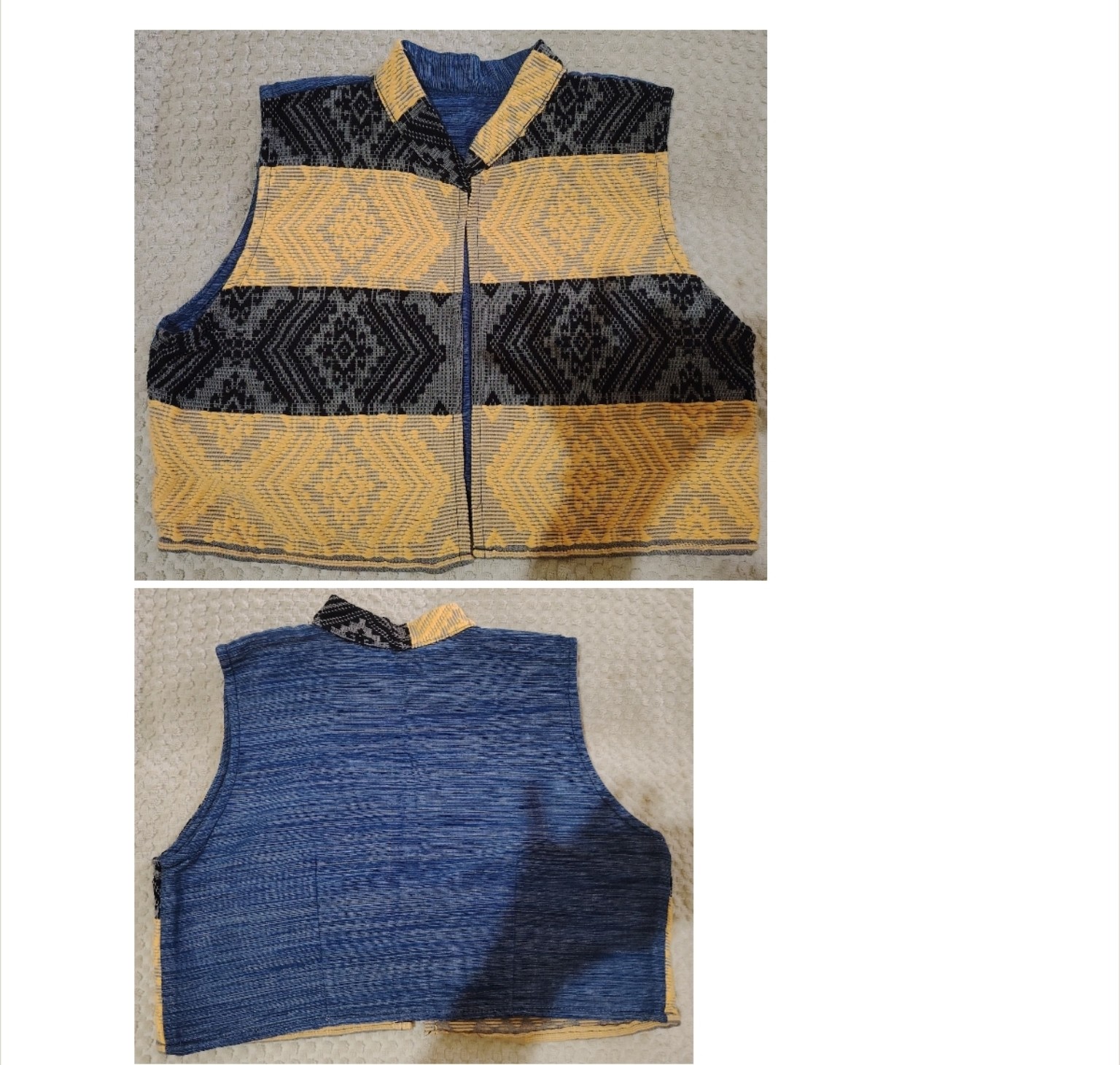
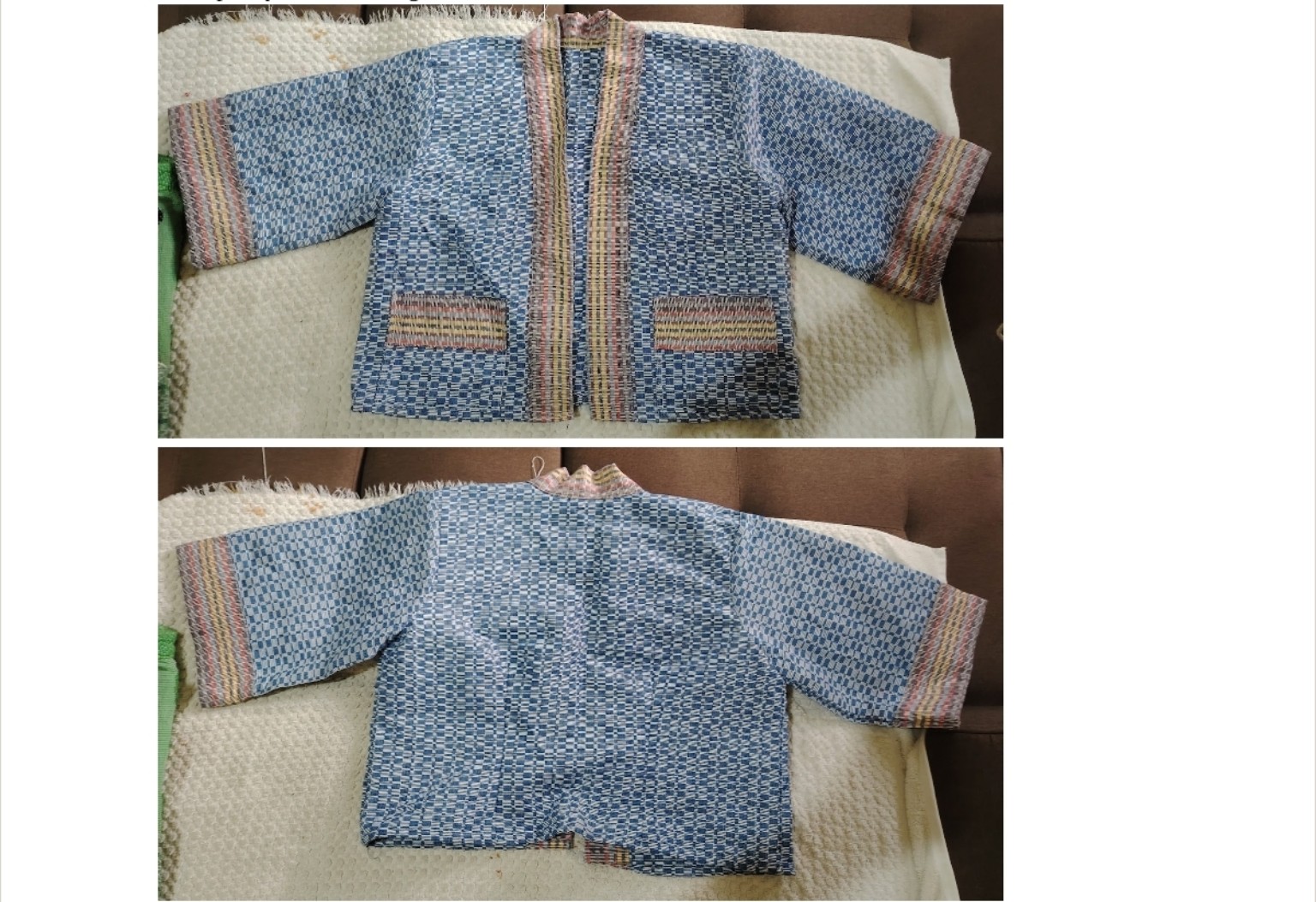
Read the cloth
Inabel, Habi, Binakul, Pinilian
Inabel
A broad name for handwoven cloth associated especially with Ilocos. Inabel is not one fixed design; the cloth can carry different structures, patterns, materials, and local histories.
Habi
The act and process of weaving: interlacing warp and weft. In the Salaysay work, Habi also names collaboration with weavers and the translation of woven cloth into contemporary use.
Binakul
A geometric weave or pattern found in Northern Luzon traditions, including Ilocos and Abra. Contrasting positive-and-negative forms create rhythm and apparent movement.
Pinilian
From the Ilocano pili, “to choose”: a supplementary-weft technique in which selected threads are picked and inserted to build raised motifs.
Names, techniques, and meanings can vary by community, weaver, and context. TÁWID™ states provenance and interpretation only where these can be verified.
 TÁWID™ · Carry Your Story