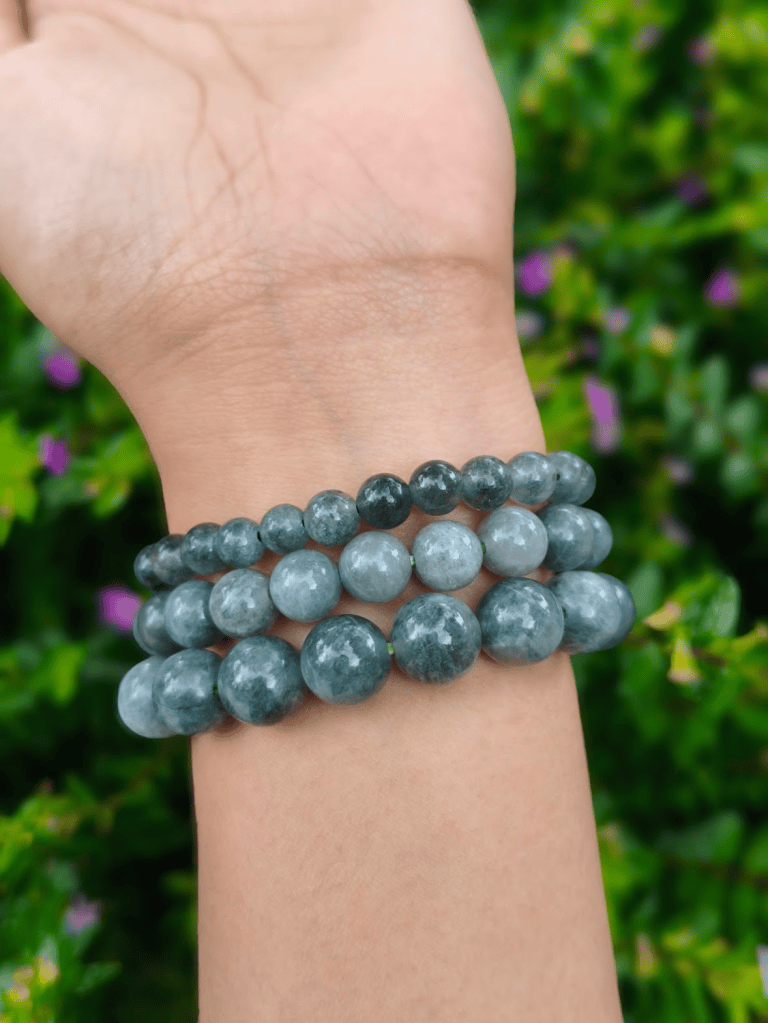
Choose your bead size and wrist circumference on the order form. Our team will confirm available materials and the final price before payment.
NEPHRITE JADE
International Meaning: Scientific and Historical
Scientific
Nephrite is a calcium magnesium iron silicate belonging to the amphibole group, with the general formula Ca₂(Mg,Fe)₅Si₈O₂₂(OH)₂. It forms through regional metamorphism under high pressure and relatively low temperature conditions, typically in subduction zone environments.
Unlike jadeite (a pyroxene mineral), nephrite consists of tightly interlocking fibrous crystals of tremolite–actinolite. This microcrystalline structure gives nephrite extraordinary toughness — not hardness alone, but resistance to fracture.
Mineralogical properties:
• Chemical formula: Ca₂(Mg,Fe)₅Si₈O₂₂(OH)₂
• Mineral group: Amphibole
• Crystal system: Monoclinic
• Hardness: 6–6.5 (Mohs)
• Exceptional toughness due to interlocking fibers
This toughness made nephrite highly suitable for tools, weapons, and ritual objects in prehistoric societies.
Early Global History
Nephrite jade has been used since the Neolithic period. In China, jade artifacts appear as early as 5000 BCE in the Liangzhu culture, where jade bi discs and cong tubes symbolized cosmological authority.
Confucian philosophy later elevated jade as a metaphor for moral virtue. The Book of Rites (Liji) associates jade with benevolence, righteousness, wisdom, and integrity.
Unlike gemstones valued for brilliance, jade’s cultural importance derived from durability, smoothness, and subtle luster.
In Central Asia and Siberia, nephrite was used for tools and ornaments, spreading across Eurasia through trade networks.
The Austronesian Jade Exchange (Critical Philippine Context)
This is where nephrite becomes directly relevant to Philippine heritage.
Archaeological research has identified Taiwan as a major prehistoric source of nephrite used across Island Southeast Asia between 2000 BCE and 1000 CE.
The “Lingling-o” ear ornaments found in the Philippines, Vietnam, and Malaysia have been traced through mineralogical analysis to nephrite sources in eastern Taiwan.
This distribution demonstrates a vast Austronesian maritime trade network long before European contact.
Philippine sites such as:
• Batanes
• Palawan
• Cagayan Valley
• Butuan
have yielded nephrite artifacts associated with social prestige and exchange systems.
Nephrite was not merely ornament — it was a marker of long-distance connectivity, technological skill, and inter-island diplomacy.
The so-called “Jade Culture” of Southeast Asia reflects one of the earliest documented regional exchange systems in Philippine prehistory.
TAWID
Nephrite Jade aligns with pamaná (inheritance) and ugnayang-dagat (maritime connection).
In Tawid framing, nephrite is not about imperial symbolism as in China, but about Austronesian mobility and shared ancestry.
It represents:
• Inter-island exchange
• Maritime identity
• Kinship across water
• Craftsmanship as cultural memory
Nephrite embodies continuity — a stone physically strong and historically tied to the movement of people across the sea.
Unlike gemstones of conquest, nephrite in Philippine context symbolizes networked communities rather than centralized empire.
“Ugnayang-Dagat” (Sea-Bound Connection)
or
“Pamanang Bato” (Stone Inheritance)
BLESSING THE WEARER
May you remain strong in heritage, connected across generations, and rooted even as you journey far.
 TÁWID™ · Carry Your Story
Leave a comment