
Bracelet sizes & prices
Prices in Philippine pesos, per finished bracelet, for the named variants below. Our team confirms availability, wrist fit, and the final amount before payment.
Lapis Lazuli
| Bead size / style | Price per bracelet |
|---|---|
| 6 mm | ₱799.00 |
| 8 mm | ₱999.00 |
| 10 mm | ₱1,199.00 |
| 12 mm | ₱1,399.00 |
| 4 mm | ₱499.00 |
| 14 mm | ₱1,799.00 |
| Chipstone | ₱350.00 |
Choose your bracelet and send an order inquiry · View the complete price guide
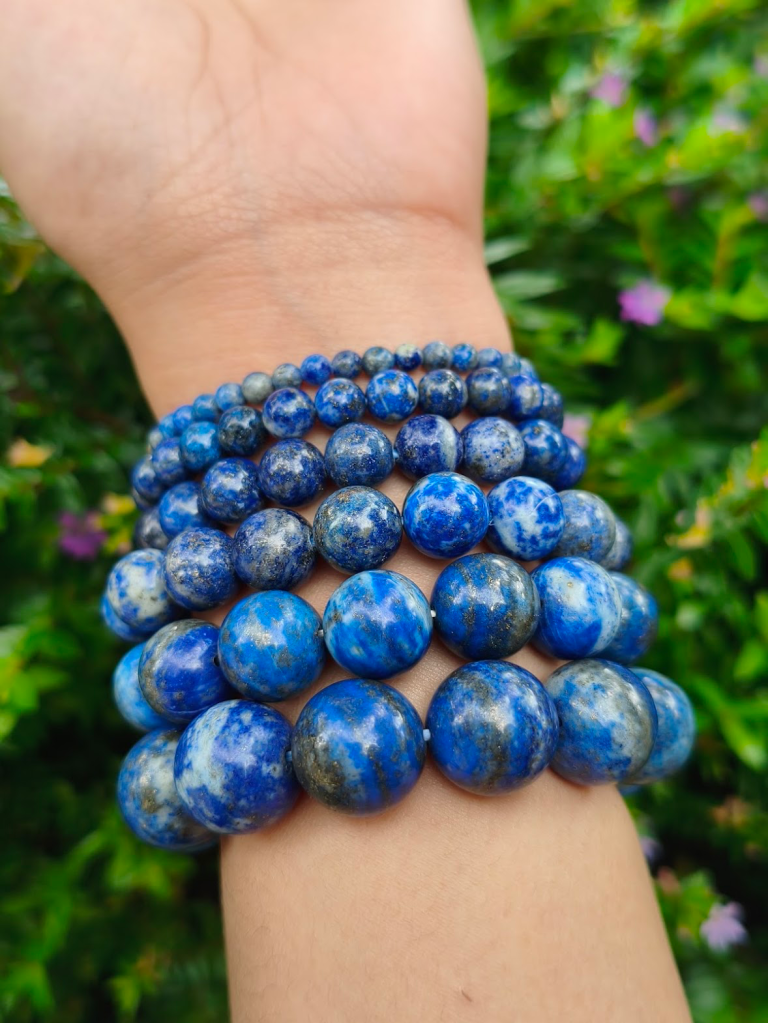
Choose your bead size and wrist circumference on the order form. Our team will confirm available materials and the final price before payment.
Material reference
Lapis Lazuli · Dunong ng Ninuno
Scientific identity, documented history, and community contexts are presented with sources. TÁWID’s contemporary design interpretation is identified separately.
Material identity
Lapis lazuli is a rock composed of several minerals rather than one mineral species. Its characteristic blue is associated with lazurite; calcite may appear as pale areas and pyrite as metallic flecks. These components help explain its patterned appearance. The rock can be selected, cut and polished to emphasise different combinations of blue and accompanying minerals. [1]
Documented historical context
Lapis lazuli has a long history as a traded ornamental material. GIA identifies Badakhshan in present-day Afghanistan as an important historical source and describes the movement of blue rough by caravan to distant centres. Beads, inlays, tablets and carved objects show that lapis could serve many purposes, from adornment to the decoration of practical and ceremonial possessions. Its value depended partly on access to sources and the labour needed to transport and work it.
Lapis also crossed from lapidary craft into painting. Processing the rock yielded natural ultramarine, a costly blue pigment associated with wealthy patrons in European painting. The history is therefore also one of separation and transformation: a heterogeneous stone was prepared into a highly valued colour. A polished bead and a painted blue passage may share a material ancestry while belonging to very different economies and artistic settings. [2] [3]
TÁWID’s contemporary interpretation
Dunong ng Ninuno is TÁWID’s contemporary title for knowledge remembered and taught across generations.


Leave a Reply